Pride Month Is a Check-In, Not a Campaign
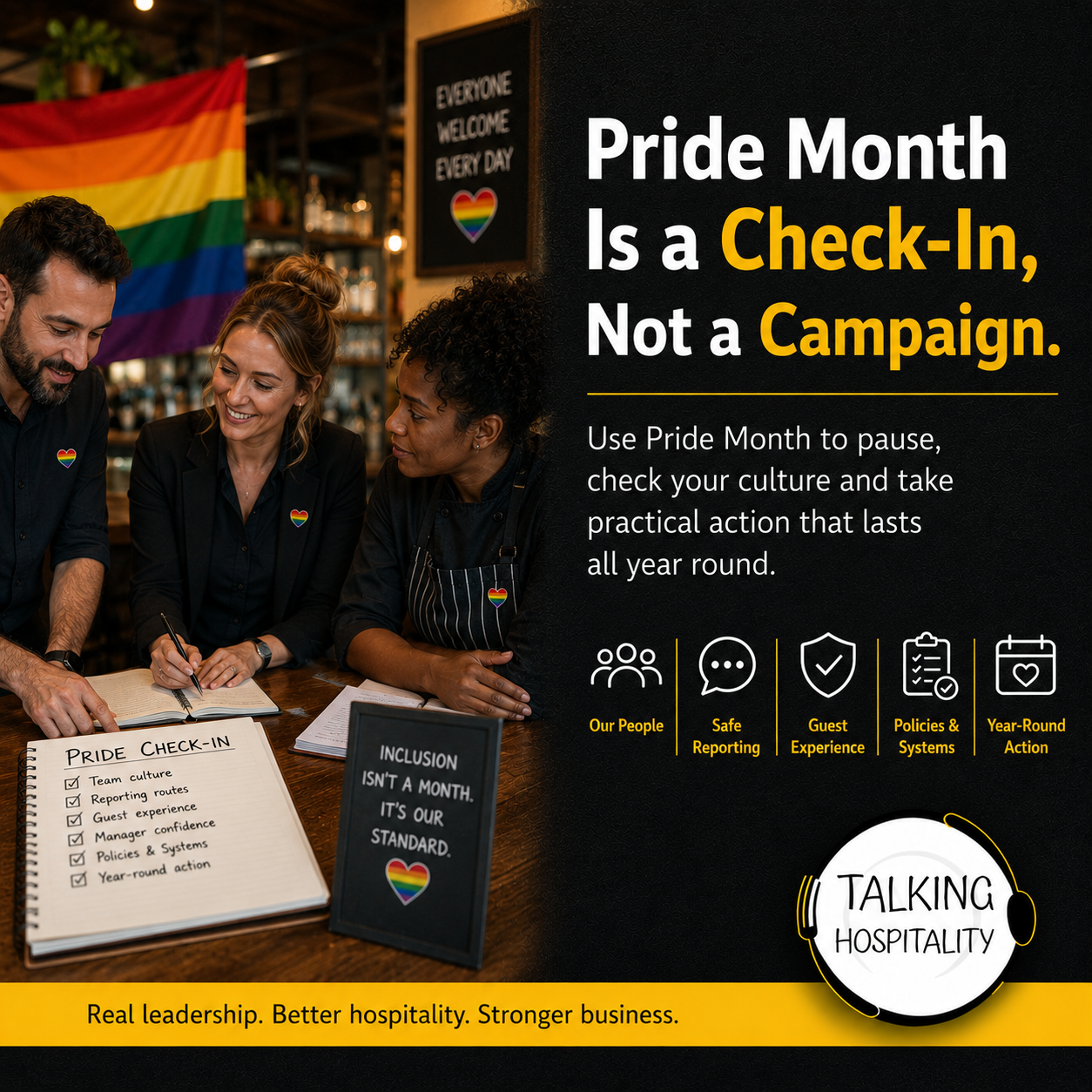
Pride Month Is a Check-In, Not a Campaign
Pride Month is here.
Cue the flags, posts, panels, themed events, colourful graphics and at least one brand somewhere discovering, with great urgency, that it has always cared deeply about inclusion since approximately last Tuesday.
That may sound a little dry, but let’s be honest. We have all seen Pride activity that feels more like a marketing obligation than a meaningful commitment.
Hospitality can do better.
Not by being perfect.
Not by issuing the longest statement known to humankind.
Not by asking one LGBTQIA+ team member to “just sense check this quickly” while they are trying to run a shift, cover a sickness absence and work out why table 14 has ordered like it is a competitive sport.
Hospitality can do better by treating Pride Month as a check-in.
A proper one.
Not “have we changed the logo?”
Not “have we posted something cheerful?”
Not “have we remembered where the rainbow bunting lives?”
A real check-in asks: what is it actually like for LGBTQIA+ people in our business?
That includes team members, guests, suppliers, freelancers, performers, event bookers, trainers, contractors and future leaders.
Because Pride Month should not be the annual moment where inclusion becomes visible.
It should be the annual moment where leadership becomes honest.
The 2026 reality check
In 2026, hospitality leaders are operating in a different climate.
Teams are more vocal about workplace culture. Guests are more alert to whether brands mean what they say. Employment responsibilities are becoming more proactive. Younger workers are more likely to expect inclusion as part of normal professionalism, not a special project.
And the old defence of “nobody has complained” is looking weaker by the year.
Nobody complaining does not always mean everything is fine.
Sometimes it means people do not trust the process.
Sometimes it means they have seen what happened to the last person who spoke up.
Sometimes it means the issue has been normalised as “banter”.
Sometimes it means the person has already decided to leave.
That should concern any hospitality leader who cares about retention, performance and culture.
Because good people rarely resign only on the day they hand in their notice. Often, they leave emotionally first. Then they stop contributing ideas. Then they stop putting themselves forward. Then they stop believing the business has their back.
By the time the resignation email lands, the real exit happened weeks ago.
Possibly months.
Pride is not just external marketing
The temptation in Pride Month is to start outside the business.
What are we posting?
What are we decorating?
What are we saying publicly?
What are we doing for guests?
Those things can matter. Visibility can matter. Celebration can matter. Public support can matter.
But the smarter leadership move is to start inside.
Before you post externally, walk the business internally.
What happens when a guest makes a homophobic comment at the bar?
What happens when a trans colleague is repeatedly misgendered?
What happens when a same-sex couple is treated awkwardly at check-in?
What happens when a team WhatsApp group becomes the place where “jokes” go to avoid accountability?
What happens when a junior employee raises a concern about a senior manager?
What happens when the person making the complaint is not confident, polished or easy to manage?
That last one matters.
It is easy to support people when they present their concern calmly, with bullet points and convenient evidence.
Real life is rarely that tidy.
People who feel hurt, humiliated or unsafe may be emotional. They may be unclear. They may minimise what happened. They may blame themselves. They may say, “It’s probably nothing,” when it is absolutely not nothing.
Managers need to be trained for that reality.
Not the PowerPoint version.
The manager gap
For many hospitality businesses, the biggest inclusion gap is not values.
It is manager confidence.
Most managers do not wake up thinking, “Today feels like a strong day for mishandling discrimination.” They avoid these issues because they are busy, nervous, undertrained or worried about saying the wrong thing.
That avoidance has consequences.
A general manager who does not challenge a customer’s homophobic comment has set a standard.
A head chef who lets “banter” slide has set a standard.
A supervisor who laughs awkwardly instead of stepping in has set a standard.
A senior leader who says, “We don’t want to make a big thing of it,” has absolutely made a big thing of it. Just not in the way they intended.
Inclusion is not only built by what you announce.
It is built by what you allow.
This is where hospitality leaders in their mid-30s to mid-40s have a particular opportunity. Many are now senior enough to shape culture, but still close enough to understand the pressure of service, the reality of late nights, the informal team dynamics and the speed at which small issues can turn into big ones.
You know the gap between policy and practice.
You have probably lived it.
That makes you useful.
Make Pride Month operational
The most practical way to use Pride Month is to make it operational.
That does not mean draining it of joy. Pride should have joy. It should have celebration, visibility, music, community and, where appropriate, outfits that require their own risk assessment.
But joy and operational discipline can sit together.
In hospitality, they have to.
So instead of asking, “What campaign are we running for Pride?” ask, “What are we checking this month that will make the business safer and stronger for the rest of the year?”
Start with five areas.
1. Check your reporting routes
Can team members report discrimination, harassment or unsafe behaviour easily?
Do they know who to speak to?
Can they report outside their direct manager?
Is there an anonymous route?
Are complaints recorded properly?
Are patterns reviewed?
Do people hear back after raising concerns?
Are managers trained not to dismiss things too early?
This matters because a reporting route that nobody trusts is just admin wearing a lanyard.
And in hospitality, reporting needs to reflect real working life.
Not everyone is sitting at a laptop with time to carefully draft an email. Some people are on split shifts, late finishes, casual contracts or rotating sites. Some are new to the industry. Some are worried about hours. Some are worried they will be labelled difficult.
A good reporting system should feel simple, safe and human.
Not like applying for a mortgage while distressed.
2. Check guest behaviour standards
Hospitality has always had to manage guest behaviour. That is not new.
But leaders need to be clearer about what the business will and will not tolerate.
If a customer is abusive towards LGBTQIA+ staff or guests, what should the team do?
Who steps in?
What language should they use?
When does the duty manager get involved?
When is someone asked to leave?
How is the incident recorded?
How is the team member supported afterwards?
This is especially important in venues where alcohol, late nights, events, private parties or large groups are part of the business.
You do not need to turn every incident into a courtroom drama. But you do need a standard.
A calm line such as, “We do not speak to people like that here,” can be powerful when managers know they will be backed.
That backing is the difference between a value and a poster.
3. Check your systems
Inclusion often fails in the boring places.
Booking forms.
HR platforms.
Name badges.
Email templates.
Uniform policies.
Rota systems.
Guest profiles.
Loyalty schemes.
Wedding enquiry forms.
Training records.
Event contracts.
Complaint forms.
None of these feel exciting. That is exactly why they get missed.
But systems send messages.
A wedding brochure that only refers to “bride and groom” sends a message.
A HR system that makes it difficult to use someone’s correct name sends a message.
A uniform policy that forces unnecessary gender rules sends a message.
A booking script that assumes every couple is heterosexual sends a message.
The question is whether those messages match the welcome you claim to offer.
This does not need to become a six-month transformation project. Start with the touchpoints people actually use. Fix the obvious friction. Then keep going.
Small operational changes can remove a lot of unnecessary awkwardness.
And frankly, hospitality has enough awkwardness already. Usually involving someone asking whether the kitchen can make a risotto “quickly”.
4. Check your development conversations
LGBTQIA+ inclusion is not only about safety.
It is also about progression.
Are LGBTQIA+ colleagues being developed, mentored and promoted?
Are they represented in leadership pipelines?
Are assumptions being made about who is “client-facing”, “commercial”, “credible” or “leadership material”?
Are people being subtly rewarded for fitting in rather than contributing fully?
This is where inclusion becomes more mature.
A business can be friendly and still unequal.
A team can be welcoming and still have patterns around who gets opportunity.
Pride Month is a good time to look at your talent conversations and ask whether everyone has a fair route to grow.
Not just to be accepted.
To progress.
5. Check your public message against lived experience
This is the uncomfortable one.
Does your Pride content match what your people experience?
If the answer is yes, brilliant. Keep building.
If the answer is no, do not panic. But do not pretend either.
People can spot the gap between branding and behaviour very quickly now. Team members see it. Guests see it. Communities see it. Future employees see it. And once trust is dented, a brighter graphic will not fix it.
So before publishing anything, ask:
Can we evidence what we are saying?
Are we supporting LGBTQIA+ people beyond June?
Are we paying LGBTQIA+ performers, speakers, trainers and creators properly?
Are we partnering with organisations in a meaningful way?
Are we making this about community impact or brand polish?
Are we prepared to stand by this message when it is inconvenient?
That final question is the one that separates support from decoration.
Use storytelling properly
One reason PrideWide’s work is so relevant to hospitality is its focus on storytelling.
Stories change how people understand each other.
And hospitality is full of stories.
The first job that gave someone confidence.
The venue where someone met their chosen family.
The manager who backed a team member when a guest crossed the line.
The hotel that made a same-sex wedding feel completely ordinary, which is exactly what made it special.
The bar where someone could hold hands without scanning the room first.
The colleague who finally felt able to talk about their partner without editing the sentence.
These stories matter because they move inclusion from theory to life.
Hospitality leaders can use Pride Month to invite better conversations, but they need to do it with care.
Do not force people to share personal stories.
Do not turn someone’s identity into content.
Do not assume LGBTQIA+ colleagues want to be visible at work.
Do not make one person the face of everything.
Instead, create safe ways for people to contribute if they choose to. Share organisational stories. Highlight practical changes. Celebrate community partnerships. Give people permission to speak without making them perform.
There is a difference between storytelling and extraction.
Good leaders know the difference.
A simple Pride Month leadership check-in
Here is a practical version hospitality leaders can actually use.
Book 90 minutes with your general manager, people lead, operations lead and one or two trusted managers from the floor.
Ask these questions:
What are the most likely LGBTQIA+ inclusion risks in our business?
Where could a guest, team member or performer feel unsafe, awkward or unsupported?
What would our managers do if a customer made a homophobic, bi-phobic or transphobic comment?
Are our reporting routes simple and trusted?
Do our systems create unnecessary barriers around names, pronouns, gender, relationships or family structures?
Have we reviewed our team WhatsApp groups and informal communication standards?
Are LGBTQIA+ colleagues included in development and progression conversations?
What are we doing after Pride Month that proves this is not just a campaign?
Then choose three actions.
Just three.
One action for team safety. One action for guest experience. One action for leadership accountability.
Give each action an owner and a deadline.
That is how Pride becomes operational.
What this could look like in practice
A hotel might update its wedding enquiry language, brief front office teams on respectful check-in assumptions, and add guest harassment scenarios to duty manager training.
A restaurant group might review team reporting routes, train managers on challenging discriminatory comments from guests, and audit staff uniform options.
A pub company might set clearer behaviour standards for customers, review late-night incident logs for patterns, and create a simple manager script for stepping in when “banter” crosses the line.
An events venue might review performer contracts, backstage safety, dressing areas, security briefings and Pride event planning.
A hospitality head office might check HR systems, recruitment language, leadership development data and employee listening channels.
None of this is wildly dramatic.
That is the point.
Good inclusion is often made up of practical, slightly unglamorous actions done consistently.
Very annoying for anyone hoping that one rainbow cupcake would sort it.
Keep the joy, add the backbone
Pride Month can and should be joyful.
Hospitality knows how to host joy. That is one of the things we do best.
But joy without safety is fragile.
Celebration without accountability is thin.
Visibility without action is wallpaper.
So yes, celebrate Pride Month. Host events. Share stories. Support LGBTQIA+ organisations. Book performers. Raise money. Create moments of colour, connection and community.
But also check the plumbing.
Check the reporting route.
Check the guest standards.
Check the manager confidence.
Check the systems.
Check the progression data.
Check whether people actually feel safe enough to be honest with you.
Because LGBTQIA+ inclusion is not a June campaign.
It is part of how you lead, host, employ, protect and welcome people every day.
Pride Month is the reminder.
The work is the rest of the year.
Call to action
Explore our Pride Month episodes, including our conversations with PrideWide, around trans people and local drag performers, and use them as practical conversation starters with your teams.
Then do the real leadership work: choose three actions, give them owners, and check back in before Pride Month becomes another folder in last year’s marketing drive.

Founder & Host
Timothy R Andrews is the founder and host of Talking Hospitality, a UK hospitality podcast, media and learning platform for experienced industry leaders.
With more than 20 years’ experience in hospitality and recruitment, including 16 years running his own hospitality recruitment business, Timothy brings a strong people, leadership and talent perspective to the conversations he hosts.
Through Talking Hospitality, he explores the issues shaping the industry across People & Culture, Operations and Technology, bringing together operators, founders, people leaders and industry specialists to share experience, challenge assumptions and identify practical ways forward.
Alongside the podcast, Timothy works across hospitality media, events, training and learning, with a particular interest in leadership, career progression, inclusion, learning and development, and how new technology is changing the industry. He also wrote **Only A Pavement Away**, performed by Cameo Williams, supporting the hospitality charity Only A Pavement Away.
October Tipping Changes: Why Worker Involvement Matters