Statutory Sick Pay in Hospitality: What Employers Need to Know
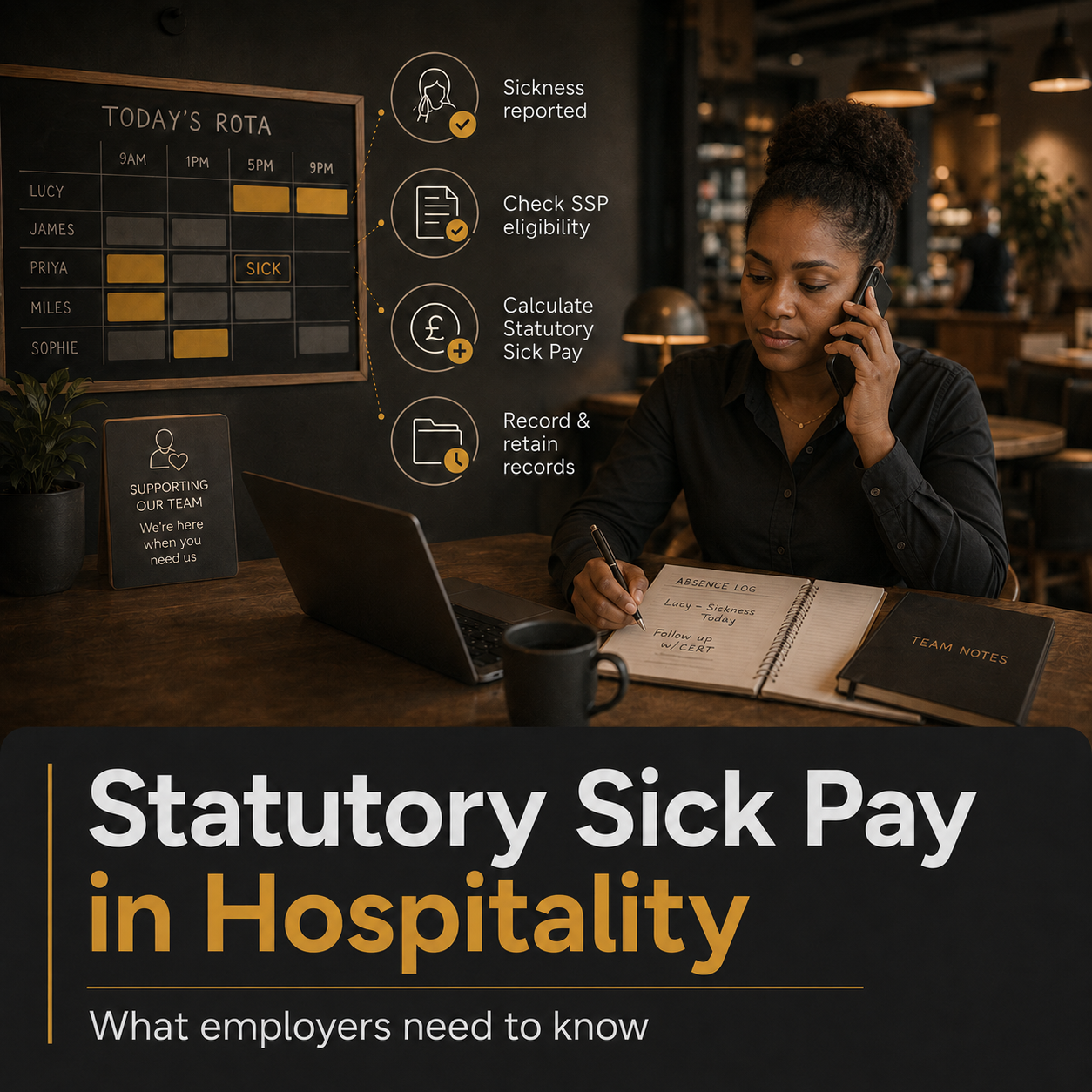

Blog 2 of 5 in the Talking Hospitality series on the Employment Rights Act 2025.
There is a particular kind of panic that hits when someone calls in sick 45 minutes before service.
The rota suddenly has a hole in it. The kitchen is already stretched. The duty manager is trying to find cover while answering guest complaints. Someone is asking whether they can stay late. And, somewhere in the background, payroll is trying to work out whether the person who has called in sick is entitled to Statutory Sick Pay.
That pressure is real. So is the employee’s need for financial security when they are ill.
From 6 April 2026, the Employment Rights Act 2025 changes the way Statutory Sick Pay works across the UK. For hospitality businesses, particularly those employing part-time, lower-paid and variable-hours workers, this is not just a payroll adjustment. It affects absence management, manager confidence, rota planning, workplace culture and staff retention.
So, what has changed: and what should hospitality employers do now?
> Important: This article is general information for hospitality leaders, operators, HR and people professionals. It is not legal advice. SSP rules, official guidance and transitional arrangements can change, so check the latest information from GOV.UK, HMRC or a qualified employment adviser before making decisions about a particular employee.
What has changed with Statutory Sick Pay?
The two headline changes from 6 April 2026 are straightforward:
- The Lower Earnings Limit has been removed.
- The waiting period has been removed.
This means eligible employees can receive SSP regardless of their earnings, and SSP can be payable from the first full day of sickness absence, rather than from the fourth day under the previous rules.
The rate is the lower of:
- 80% of normal weekly earnings, or
- the applicable flat weekly rate.
The published guidance currently refers to a flat weekly rate of £123.25, but employers should check the latest official figure and calculation guidance before processing payments.
The word “eligible” still matters. The changes do not mean every worker automatically receives SSP in every situation. Employers must still consider the relevant conditions, employee status, notification requirements and the details of the absence.
The February 2026 Employer Bulletin gives employers a useful overview, while the Business Growth Service guidance sets out the practical actions businesses should take.
Why does this matter so much in hospitality?
Because hospitality does not have one standard workforce.
A business may have full-time chefs, part-time front-of-house colleagues, seasonal workers, students, housekeeping teams, casual staff and people working irregular patterns across several venues. Some employees may work a regular 40-hour week. Others may work two shifts one week and five the next.
Under the previous system, some lower-paid employees could fall below the earnings threshold for SSP. Others would not receive SSP for the first few days of a short illness because of the waiting period.
Those barriers have now gone.
That means a part-time team member who previously received no SSP for a short absence may now qualify, provided they meet the relevant conditions. It also means employers need to make sure their systems can handle a more varied set of calculations.
This is where the operational concern comes in. As hospitality operators told the Morning Advertiser, the reforms arrive alongside rising costs, tight margins and an already demanding labour environment.
But there is a danger in seeing the change only as another cost or administrative burden. If someone is choosing between staying home with a stomach bug and losing pay, the old system could create a pretty grim incentive to come to work unwell.
That is bad for the employee, bad for colleagues and not exactly brilliant for guests either.
The payroll challenge: small errors can become big problems
The first practical job is to speak to your payroll provider.
Your system needs to be ready to:
- recognise SSP eligibility without relying on the old Lower Earnings Limit;
- calculate payment from the first full day of sickness where applicable;
- calculate 80% of average or normal weekly earnings correctly;
- compare that figure with the applicable flat weekly rate;
- deal with irregular hours and variable pay;
- process ongoing absences that cross 6 April 2026;
- keep a clear record of how each calculation was reached.
Variable-hours workers deserve particular attention. If your business uses zero-hours, seasonal or casual arrangements, do not assume the calculation will be identical for every employee.
Create a simple process for checking:
- the employee’s role and status;
- when the sickness absence started;
- which days count for the purpose of the absence;
- the relevant earnings period;
- whether the employee has provided the required notification;
- what SSP rate applies.
This is not about turning a restaurant manager into a payroll technician. It is about making sure the right people know what information to collect and when to pass it on.
Do not forget transitional cases
Some absences will cross the changeover date.
The GOV.UK guidance on sickness absences that start before and end on or after 6 April 2026 explains how different cases should be handled. For example, some employees who were not entitled under the old earnings rules may become entitled from 6 April, while other long-running absences may fall outside the transitional provisions.
There are also specific rules for people who were already receiving SSP, employees who were serving waiting days and absences that restarted immediately before the new rules came into force.
The practical message is simple: do not apply one blanket approach to every absence that crosses the date.
If you have an ongoing case, check the current guidance carefully. If the situation is complex, get professional advice. Guessing your way through payroll is a false economy.
Absence management is not the same as performance management
This is the bit that needs some straight talking.
An employee being sick is not automatically a performance problem. Nor is it automatically misconduct.
A team member with repeated absences may need support, an occupational health referral, a reasonable adjustment, a return-to-work conversation or a clearer understanding of the reporting process. They may also need a fair review of whether the role, workload or working environment is contributing to the problem.
That does not mean employers cannot manage attendance. Of course they can. Hospitality businesses need reliable teams, and repeated short-notice absence can put considerable pressure on everyone else.
The point is that the process must distinguish between:
- genuine illness;
- a health condition or disability;
- poor communication or failure to follow the absence procedure;
- an underlying workplace issue;
- and a conduct or performance concern that needs to be managed separately.
A manager saying, “You’ve let the team down again,” may feel understandable in the heat of service. It is rarely a helpful starting point.
A better conversation might be:
> “I’m sorry you’re unwell. Let’s make sure we understand what support you need, what the reporting process is, and when we should check in again.”
That is not soft management. It is competent management.
Train managers before the next busy weekend
Policies are only as good as the people applying them.
Site managers, supervisors and duty managers should understand:
- how employees report sickness;
- who needs to be informed and by when;
- what information can reasonably be requested;
- how to record the absence;
- when to refer a question to HR or payroll;
- how SSP works at a high level;
- how to hold a supportive return-to-work conversation;
- when an absence may require a more formal review;
- how to avoid discriminatory assumptions or inconsistent treatment.
This matters especially in hospitality, where managers are often promoted because they are excellent operators: not because they have received extensive people-management training.
Give them a short, practical guide. Use real scenarios:
- A bartender calls in sick before a Saturday night shift.
- A part-time housekeeper earns below the old threshold.
- A chef has an ongoing absence that began before 6 April.
- A team member has frequent absences linked to an existing health condition.
- An employee does not follow the agreed notification process.
Then agree what happens in each case. Clear steps reduce the chance of a manager improvising under pressure.
Fair processes support culture and retention
A fair absence process is not just about compliance. It tells people what kind of employer you are.
If one manager questions every absence while another approves everything without recording it, employees quickly notice. Inconsistent treatment breeds resentment. People stop trusting the process: and may start looking for the exit.
That is why SSP and absence management connect directly to hospitality staff retention and hospitality workplace culture.
People are more likely to stay when they believe:
- they will be treated consistently;
- they can be ill without being shamed;
- their health will be taken seriously;
- expectations are clear;
- managers know how to handle difficult conversations;
- operational pressure will not simply be dumped on the least powerful person in the room.
This does not remove the need for accountability. It makes accountability fairer.
As the Morning Advertiser’s coverage of the changes highlighted, the Fair Work Agency is intended to bring more employment-rights enforcement together. The agency’s role and the scope of its enforcement should be monitored through current official guidance, but the direction of travel is clear: accurate records and consistent processes matter.
You should be able to explain what happened, what information was considered and why a decision was made.
A practical SSP checklist for hospitality operators
Use this as a starting point:
- Check your payroll provider has updated its SSP calculations.
- Review sickness policies, handbooks and contracts.
- Remove outdated references to the Lower Earnings Limit and three waiting days.
- Confirm how variable-hours and seasonal employees will be assessed.
- Review any enhanced or contractual sick pay arrangements.
- Create a clear absence-reporting process for every site.
- Train managers and supervisors on the new rules.
- Explain the changes to employees in plain English.
- Check transitional cases that began before 6 April 2026.
- Record all sickness absences accurately, including short absences.
- Review how return-to-work conversations are handled.
- Separate health support from conduct or performance processes.
- Audit absence records regularly for consistency and accuracy.
- Monitor updates from GOV.UK, HMRC and the Fair Work Agency.
- Seek specialist advice where an individual case is complex.
You may also want to review Talking Hospitality’s practical conversations on what HR really does in hospitality and what makes people stay in hospitality jobs.
The real test is how we respond when the rota breaks
The new SSP rules will create work for hospitality employers. There is no point pretending otherwise.
Payroll systems need updating. Managers need training. Budgets may need revisiting. Absence records need to be more accurate. Busy services will still be busy when someone is ill.
But a rota is not a moral contract. It is a planning tool.
When absence happens, the job of hospitality leadership is not to punish the person who is unwell for creating an inconvenient gap. It is to build enough clarity, trust and operational resilience that the business can respond without making the situation worse.
That means supporting employees properly, managing attendance fairly and planning for the reality that people sometimes get sick.
Because if our staffing model only works when nobody catches a cold, pulls a muscle or needs a day off, the problem is bigger than Statutory Sick Pay.
The next article in this five-part series will look at probation and unfair dismissal: and why hospitality managers may need to rethink how they support people in their first months at work.
October Tipping Changes: Why Worker Involvement Matters