
Employment Reforms and Hospitality Rotas: Balancing Flexibility with Predictability
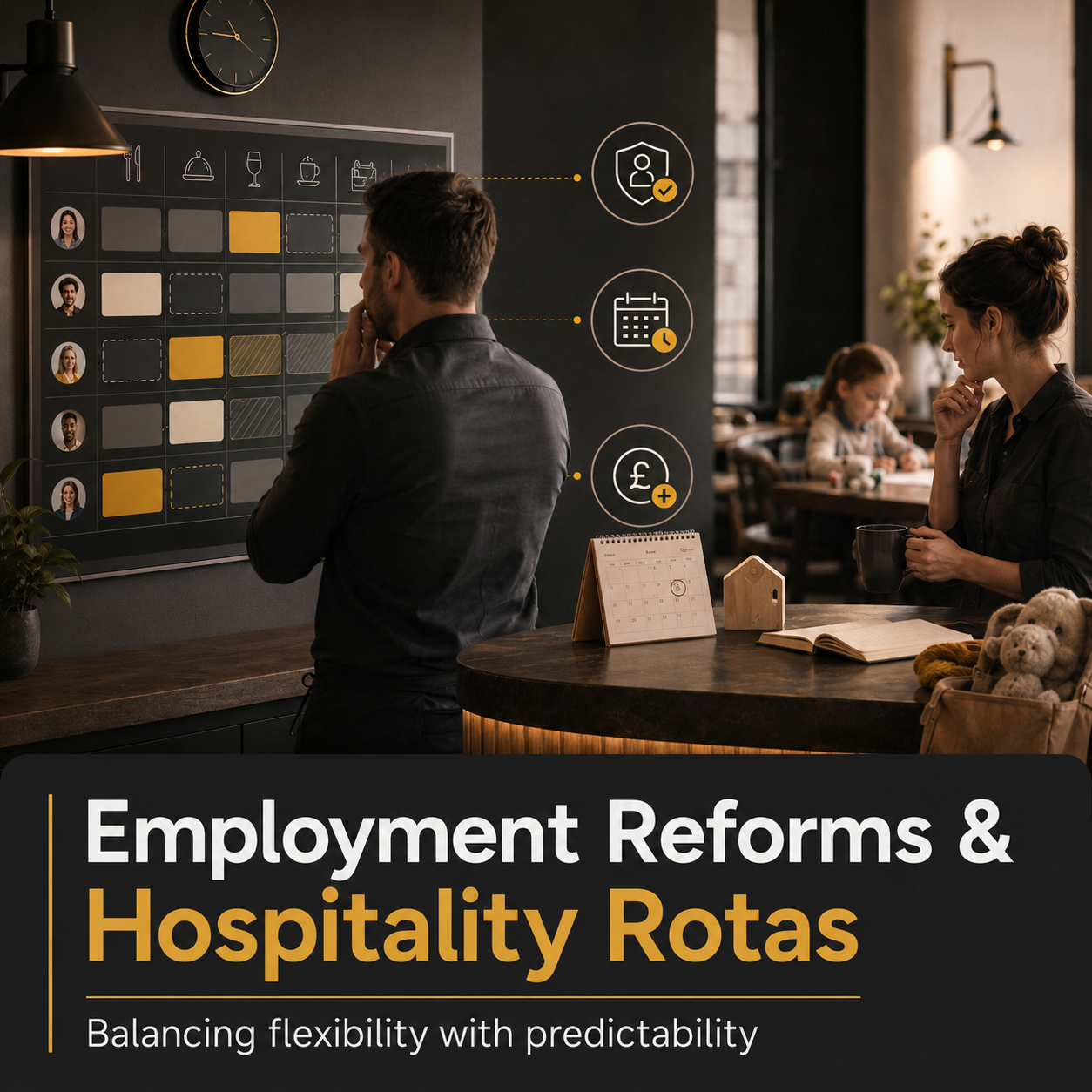
Employment Reforms and Hospitality Rotas: Balancing Flexibility with Predictability

How do you balance flexibility for the business with more predictability for your people?
That is the question hospitality leaders need to be asking now.
Not when every detail of the employment reforms has been finalised. Not when a new system lands in the inbox with a frightening deadline attached. Now.
The Government is consulting on how to implement measures in the Employment Rights Act 2025 affecting zero-hours and low-hours workers, including:
- A right to guaranteed hours based on actual working patterns over a reference period
- A right to reasonable notice of shifts and rota changes
- A right to payment when shifts are cancelled, curtailed or moved at short notice
These measures have not yet taken effect. They are currently subject to the official GOV.UK consultation, which closes at 11:59pm on 25 August 2026.
For hospitality, this is not a minor HR adjustment. Rotas are the operating system of the business. They determine whether the kitchen opens, whether the bar can cope with a rush, whether labour costs stay under control and whether someone gets home in time to see their children.
Get the balance wrong and the business carries unnecessary cost. Get it wrong in the other direction and your people are left trying to build a life around a rota that behaves like a slot machine.
What is being proposed?
The primary source here is the Government’s official consultation: Make Work Pay: ending one-sided flexibility – reforms of zero hours and similar contracts. It sets out how ministers are consulting on implementation of three measures in the Employment Rights Act 2025 designed to create greater security and predictability for people working variable hours.
Those three measures have not yet taken effect. The consultation remains open until 11:59pm on 25 August 2026.
The proposals cover three main areas, with Morning Advertiser still useful here for operator-facing reaction and legal commentary.
1. Guaranteed hours
Under the consultation, qualifying workers could gain a right to be offered guaranteed hours reflecting the hours they actually work over a reference period.
Workers who regularly work a particular pattern could become entitled to a contract reflecting the hours they actually work.
That matters because there is often a gap between the contract on paper and the reality on the rota. Someone may technically be on a zero-hours contract, but if they have worked every Tuesday, Thursday and Saturday for the last six months, that arrangement is not exactly unpredictable from the operator’s perspective.
The consultation is asking how eligibility should work, including the relevant threshold and reference period.
UKHospitality has argued that the rules should recognise the seasonal nature of the sector. In recent Morning Advertiser coverage, the trade body called for a reference period of either 26 or 52 weeks, rather than a shorter window that could distort the picture during a busy or quiet period.
It has also suggested an eight-hour threshold and criteria requiring workers to have worked regularly for at least 10 out of 12 weeks and at least 20% more than their contracted hours.
Those are UKHospitality’s recommendations, not final law. But they show where the debate is heading.
2. More notice of shifts
The consultation also covers a right to reasonable notice of shifts, including when shifts are offered, changed or cancelled.
Most hospitality managers understand that life happens. A booking changes. A delivery fails. The weather turns. A team member calls in sick. An event suddenly takes off.
But there is a difference between genuine operational change and treating people’s availability as an endlessly adjustable resource.
For employees, a late rota can mean cancelled childcare, lost income, missed education or a second job they can no longer attend. For businesses, a requirement for longer notice could make it harder to respond to demand.
The challenge is not pretending that hospitality can plan every service perfectly. It cannot. The challenge is building a planning process that treats last-minute change as the exception, not the business model.
3. Compensation for cancelled or curtailed shifts
The consultation also covers a right to payment when shifts are cancelled, curtailed or moved at short notice.
Again, the exact rules and payment levels are not yet final. But the principle is clear: if a person has committed time to a shift and the business removes that work at the last minute, there may be a financial consequence.
That should make every operator look closely at how often shifts are being cut, who authorises those decisions and whether the cost is already appearing elsewhere through frustration, disengagement and staff turnover.
Sometimes a “saving” on one shift is simply a bill sent to your retention strategy.
The hard truth: flexibility has not always been mutual
Hospitality needs flexibility. Of course it does.
Demand moves quickly. Seasonal trading creates peaks and troughs. Events, weather, tourism and local footfall can all change the shape of a week. A rigid staffing model would be as useful as a chocolate teapot on a Saturday night.
But flexibility has not always been mutual.
Businesses have often expected people to keep their availability open without offering reliable hours in return. Staff are told to be adaptable, but the business does not always adapt to the realities of their lives.
That is where workplace culture becomes part of the rota conversation.
A rota is not just a spreadsheet. It is a message from leadership.
It tells people whether their time is respected. It shows whether managers plan properly. It reveals whether the business sees employees as professionals with commitments or simply as names to move around until the numbers work.
As we have explored in What makes people stay in hospitality jobs, retention is rarely driven by one grand gesture. It is built through the repeated, everyday experience of working somewhere.
A predictable rota will not solve every retention problem. But an unpredictable rota can create plenty.

What should hospitality operators do now?
There is no need to wait for the final legislation before improving rota practice. In fact, waiting could leave you trying to rebuild the engine while the car is moving.
Here are five practical steps.
1. Audit the gap between contracts and reality
Look at the last six to twelve months of working patterns.
Who is officially on zero hours but regularly works the same shifts? Who consistently works more hours than their contract suggests? Which team members are being relied on as permanent fixtures while remaining commercially or contractually “temporary”?
Do not only look at average hours. Look at patterns:
- Regular days of work
- Consistent start and finish times
- Repeated weekly commitments
- Seasonal variations
- Regular additional shifts
- Differences between direct employees and agency workers
This will give you a much clearer view of the workforce you actually have.
2. Create core hours with optional flexibility
A useful model may be to separate guaranteed core hours from additional voluntary hours.
For example, someone might have a reliable baseline of 16 hours each week, with the option to pick up extra shifts during busy periods. The business still has flexibility. The employee has a more dependable foundation.
This is not about removing choice from people who genuinely prefer variable hours. Some workers want flexibility, particularly students, parents, semi-retired people or those balancing more than one role.
The point is to stop assuming that one contract type works for everybody.
Good hospitality leadership means asking people what flexibility means to them, rather than deciding on their behalf.
3. Set a rota publication standard
Choose a minimum period for publishing rotas and make it consistent.
One week may be a realistic starting point. Two weeks would give people more room to plan. Whatever standard you choose, managers need to understand that it is a commitment, not a vague aspiration.
Build exceptions into the policy for genuine emergencies. Then define what an emergency is.
If every poor forecast becomes an emergency, the word loses its meaning very quickly.
4. Track changes properly
Your rota system should record:
- When a shift was published
- When it was accepted
- Who changed or cancelled it
- When the change was made
- The reason for the change
- Whether the employee requested the change
- Any payment or adjustment made
As Lydia Button explained in the Morning Advertiser, operators should review rota design, staffing models, agency arrangements, payroll and record-keeping against the consultation themes.
This is not about creating paperwork for the sake of it. Clear records help you understand where the operation is genuinely unpredictable and where planning habits need to improve.
5. Train the people making the changes
A beautifully written rota policy is useless if the duty manager changes shifts through a group chat at 10.30pm and nobody knows what happens next.
Managers need practical training on:
- Giving notice
- Handling shift swaps
- Cancelling fairly
- Communicating changes
- Recording decisions
- Understanding contracted and actual hours
- Escalating repeated problems
This is also a chance to improve management capability more broadly. As we discuss in What does HR really do in hospitality?, HR should not simply arrive after something has gone wrong. It should help the business build better systems before problems become expensive.

Recruitment and retention are connected to the rota
UKHospitality has warned that the proposed changes could create barriers to hiring and restrict the sector’s ability to adapt to customer demand. It is calling for implementation not to begin before October 2028, alongside longer reference periods and clearer eligibility thresholds.
Those concerns deserve to be taken seriously. Hospitality businesses are operating under significant financial pressure, and new administrative requirements will have consequences.
But there is another side to the conversation.
If a business cannot explain when people are likely to work, how much notice they will receive and what happens when a shift is cancelled, that uncertainty can also become a barrier to recruitment.
People talk. Candidates compare employers. Hospitality workers know which venues publish rotas late, cancel shifts casually or expect availability without offering security.
So the question is not simply: “How much will compliance cost us?”
It is also:
- How much does churn cost us?
- How many candidates walk away from unpredictable work?
- How much management time is spent firefighting rota issues?
- What does instability do to service, morale and guest experience?
- Could better planning improve hospitality staff retention?
That is the more useful leadership conversation.
Flexibility should be designed, not improvised
The best rotas are not necessarily the ones that never change. They are the ones where change is managed honestly and fairly.
That means building a reliable base, communicating early, involving employees in their working patterns and recognising that short-notice disruption has a human cost.
The proposed employment reforms may create additional obligations for hospitality. They may also expose weak systems that were already costing businesses money.
So, yes, keep flexibility. We need it.
But make it structured. Make it transparent. Make it work both ways.
Because a rota should help the business respond to demand without asking people to put their entire lives on hold.
The consultation deadline is 11:59pm on Tuesday 25 August 2026. Operators should review the official GOV.UK consultation materials, seek appropriate employment advice and consider responding directly. As UKHospitality has said, it is critical that Government hears from individual businesses as well as trade bodies.
And whatever the final rules look like, the direction of travel is difficult to ignore: better planning, clearer communication and more respectful employment practices are becoming central to recruitment and retention.
That is not just a compliance issue.
It is hospitality leadership.
This article is for general information and does not constitute legal advice. The proposals discussed remain subject to consultation and further legislation. Operators should review the Government’s consultation materials and take specific professional advice on how any final measures apply to their business.
Sources
- Make Work Pay: ending one-sided flexibility – reforms of zero hours and similar contracts : GOV.UK consultation, Department for Business and Trade, open until 25 August 2026 at 11:59pm
- What is going on with zero-hour contracts? : Morning Advertiser, Lydia Button, 10 June 2026
- UKH warns zero-hours contract changes could hit sector jobs : Morning Advertiser, Gary Lloyd, 7 August 2026
Statutory Sick Pay in Hospitality: What Employers Need to Know