
Why aren't more young people choosing hospitality?
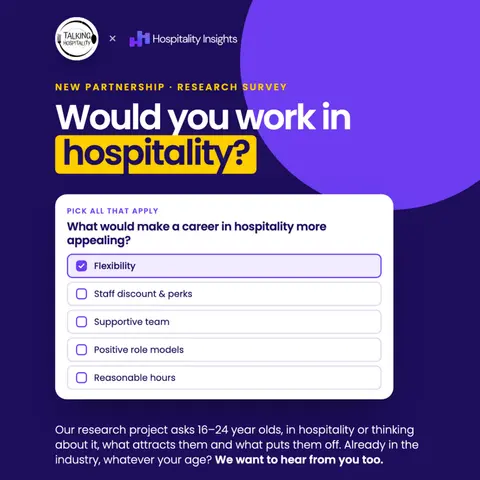
Ask a room of hospitality leaders why young people are not choosing the industry and you will get a confident answer within about three seconds. Pay. Hours. Status. Parents. Social media. It is rare for the answer to have been checked with anybody under 25.
Would You Work in Hospitality? exists to check it. It is a research partnership between Talking Hospitality and Hospitality Insights, and it asks young people directly what attracts them to hospitality, what puts them off and what would make a career in the sector more appealing. We are gathering views, not announcing conclusions. The survey asks the questions; the answers will come from the people the industry says it wants to reach.
For hospitality leaders, the answers could help guide decisions about recruitment, training and working practices. For young people, it is a chance to say what they think, whether they already work in the industry or are only considering it.
Young people are not one audience
It is easy to talk about “young people” as though they all have the same priorities. They do not. A 16-year-old choosing college courses, an apprentice trying to get enough hours, and a 24-year-old looking for a secure next step are in different situations.
The research keeps younger respondents’ views distinct by recording them in three age brackets: 16–17, 18–20 and 21–24. Everyone aged 25 and over is recorded in one combined category. This gives the analysis a way to hear younger voices separately rather than folding them into the wider workforce.
That distinction is useful for leaders. If a hotel is trying to reach school leavers, the questions those young people raise may differ from those raised by a graduate or an employee with several years’ experience. Treating their views as interchangeable risks missing the detail that could inform a better decision.
What do young people see when they look at hospitality?
The industry can offer a lot. People can take on responsibility early, learn through practical work and build skills that travel between roles and sectors. Front of house, kitchens, housekeeping, events, operations and people teams all develop different capabilities. In the right workplace, a team can also give people a strong sense of belonging.
Hospitality can create routes into management, specialist work or running a business. Some people thrive on shift-based work and the energy of a busy service. Flexible work can suit someone balancing a job with study or other commitments, particularly when rotas are planned with enough notice and employees have some say in them.
Those are genuine strengths. They do not automatically describe every job or every employer.
A young person may also ask how much they will earn, whether their hours will be reliable, how late they will finish and whether they can plan around college, family or another job. They may have heard from someone who left hospitality because of a difficult manager, unpredictable shifts or a lack of progression. They may see the industry described as a first job, rather than a place to build a career.
None of those concerns should be waved away with a list of success stories. A good career route in one group does not tell a potential entrant what the experience will be in a local pub, an independent restaurant or a contract catering team. Leaders need to explain what their own workplace offers, and be willing to acknowledge where it falls short.
Listening gives leaders something they cannot get by guessing
A manager might assume pay is the main barrier. A young person could say they cannot see what the job involves, or that they have no idea how someone moves from a first role into a more senior one. Another might be interested in the work but uncertain about late finishes and getting home safely.
Those answers point to different actions. Pay requires one kind of review; unclear progression calls for better conversations about skills and roles. Concerns about hours may prompt a look at rota notice, shift patterns and how reliably agreed hours are provided.
Listening directly can also help separate a problem in the wider industry’s reputation from a problem in an individual operation. If young people are hearing that hospitality offers few routes forward, employers can make progression more visible. If the concern is based on experiences people have had locally, communications alone will not resolve it. The working conditions need attention too.
The purpose of asking is not to collect reassuring feedback. It is to hear what people actually think, including answers that challenge an employer’s assumptions. That gives leaders a better starting point for deciding what to change and what they need to understand further.

Opportunity needs a clear explanation
Hospitality leaders often know how varied the work can be. Someone outside the sector may not. A job title or a general statement about “career opportunities” does little to show what a week looks like, what skills a person will build or what they might do next.
For an operator, making routes visible can start with concrete examples. Show how a team member developed into a supervisor, what training they received and what responsibility they now hold. Explain the difference between roles in a hotel, restaurant, pub, bar or contract catering setting. Be clear about what progression depends on, including the support and opportunities the employer provides.
Apprenticeships can give people structured learning alongside work, but the experience depends on how the training fits with the operation and whether someone has time and support to develop. Talking about apprenticeships without explaining the day-to-day support can leave potential applicants with more questions than answers. Our article on apprenticeships and recruitment explores some of those practical considerations.
The same applies to flexibility. For one young person, it may mean shifts that fit around study. For another, it may mean rotas published early enough to organise transport, caring responsibilities or a second job. Ask what flexibility means to your team before assuming the answer.
Who is running the research, and what happens to the answers
Hospitality Insights is the research partner for this project. It is an employee intelligence platform that turns people data into clear insights and actions, giving every employee a voice while protecting anonymity.
Talking Hospitality is helping distribute the survey and bring the findings into industry conversations. The research will be shared through Talking Hospitality and a joint research report, so operators can use the findings to inform their thinking and action.
The survey is open to 16–24-year-olds, whether they already work in hospitality or are thinking about it, and to anyone already working in the industry, whatever their age or role. It is anonymous, requires no sign-up and asks three quick questions. It takes approximately two minutes to complete.
Complete the Would You Work in Hospitality? survey
Help the survey reach young people
If you lead a hospitality business, taking the survey yourself is one useful first step. Then think about who in your existing network could pass it on to younger people.
In an operation, that might mean sharing the link with your team and asking managers to pass it on to apprentices or colleagues aged 16–24. It could mean sending it to a college tutor you already work with, sharing it through a local school careers contact, or forwarding it to family and community networks. Give people the link and a short explanation of the research. Participation should be voluntary, with no pressure to respond in a particular way.
If you manage several sites, include the survey in a team communication that reaches kitchen, front-of-house and housekeeping colleagues, as well as managers. If you work with a college or training provider, ask whether they can share it with relevant students. A single post is easy to miss; a direct, appropriate invitation through an existing relationship can help the survey reach people who might not otherwise see it.
You can also share the survey with people who have left the industry or who have never worked in it. Their perspectives are part of the picture too. Please do not assume that someone with no hospitality experience has nothing useful to say. Their reasons for not considering the sector are precisely the kind of views this research is designed to hear.
A practical next step for hospitality leaders
Take the survey, then pass it to one group of younger people you can reach directly: a team, apprentices, a college contact, a local school or your wider network. Ask them to respond in their own time, without trying to steer the answers.
When the findings are available, use them alongside what you hear from your own people. Compare the picture with your recruitment conversations, exit feedback, rota practices and progression routes. If young people tell us what is putting them off, the next question for each employer is specific: which part can we change in our own operation, and who needs to be involved?
That is a more useful place to start than guessing what a generation wants.

Founder & Host
Timothy R Andrews is the founder and host of Talking Hospitality, a UK hospitality podcast, media and learning platform for experienced industry leaders.
With more than 20 years’ experience in hospitality and recruitment, including 16 years running his own hospitality recruitment business, Timothy brings a strong people, leadership and talent perspective to the conversations he hosts.
Through Talking Hospitality, he explores the issues shaping the industry across People & Culture, Operations and Technology, bringing together operators, founders, people leaders and industry specialists to share experience, challenge assumptions and identify practical ways forward.
Alongside the podcast, Timothy works across hospitality media, events, training and learning, with a particular interest in leadership, career progression, inclusion, learning and development, and how new technology is changing the industry. He also wrote **Only A Pavement Away**, performed by Cameo Williams, supporting the hospitality charity Only A Pavement Away.
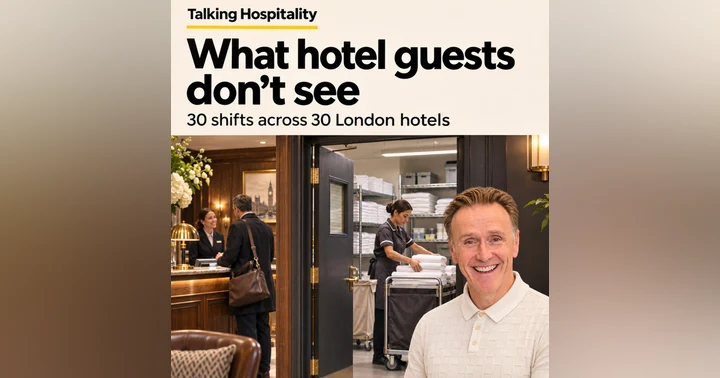
Front of House vs Back of House: What 30 London Hotels Reveal About Hospitality Operations