The People Who Build, Not Take: Cyrus Todiwala, Hospitality and the Hope Inside Enterprise
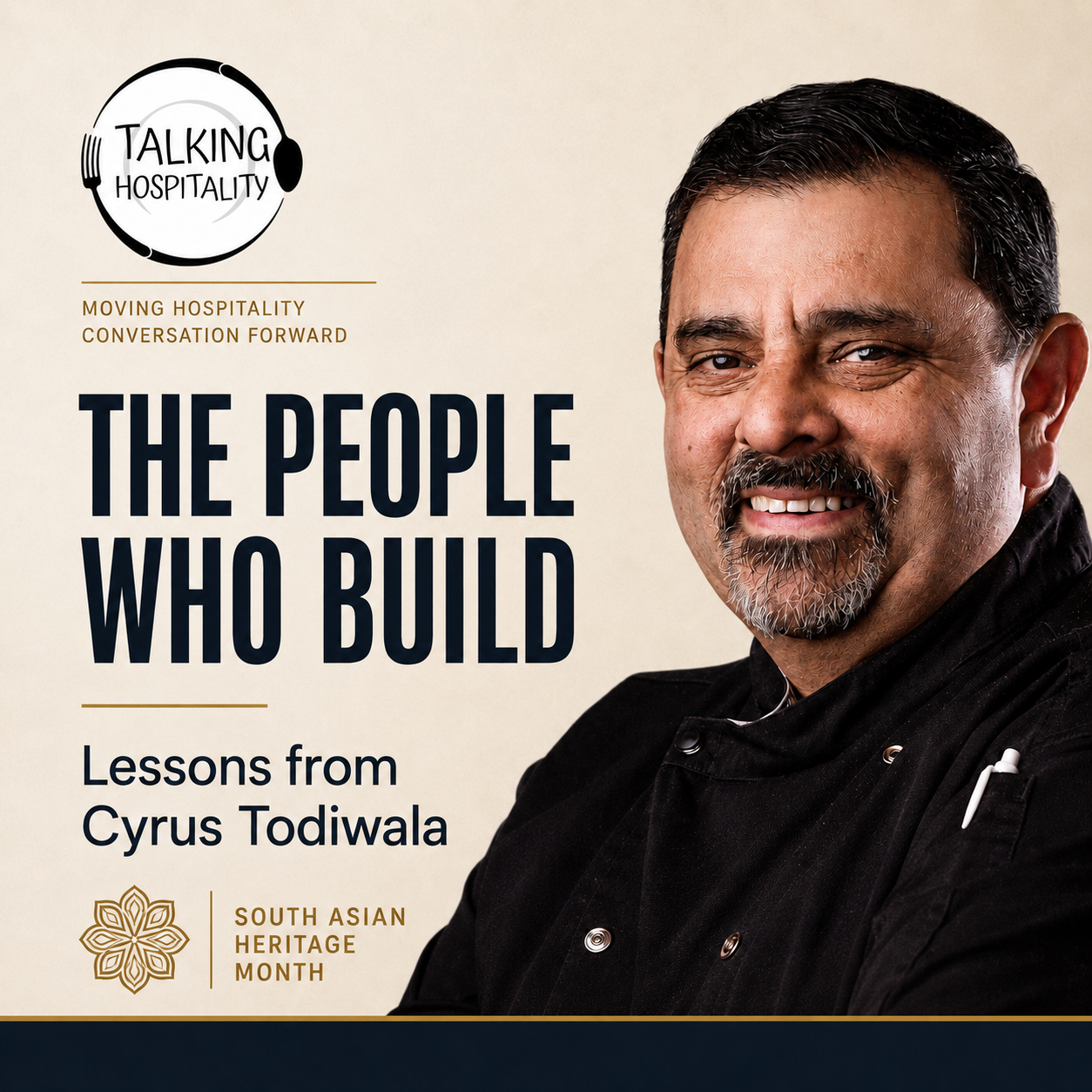
South Asian Heritage Month Series
There is a tired story that keeps being told in Britain.
You know the one.
People come here. They take jobs. They claim benefits. They change the country. They do not contribute.
It is usually said with great certainty by people who have rarely had to run a restaurant on a wet Tuesday, train a nervous young commis, cover a no-show, speak to the Home Office, rewrite a menu, calm a customer, pay a supplier, mentor a student, and still turn up the next morning ready to do it all again.
Hospitality tells a different story.
Not a perfect story. Not a sentimental story. But a much more honest one.
It tells us that people who move to the UK have not simply joined British hospitality. They have helped build it. They have opened restaurants, created jobs, trained teams, changed menus, expanded palates, revived high streets, introduced new ideas and given the industry some of its most recognisable names.
For South Asian Heritage Month, that matters.
The official theme for 2026 is “Unity in Diversity”, with the month running from 1–31 July. South Asian Heritage Month exists to celebrate, commemorate and educate, recognising the histories, cultures and contributions of South Asian communities in the UK and beyond.
So this is not me, as a white man, trying to explain South Asian experience.
That is not my place.
This is me listening back to our conversation with Cyrus Todiwala and recognising something important: his story is not just about food. It is about what happens when talent meets pressure, when resilience meets opportunity, and when someone decides that contribution matters more than complaint.
And if hospitality needs anything right now, it needs that kind of hope.
The promise of seven years
Cyrus came to the UK in 1991 after a friend from the Taj Mahal Hotel in Bombay encouraged him to join him in London. He told his parents he would be back in seven years.
As he said on Talking Hospitality, “It’s not happened yet.”
That one line says a lot. Migration stories often begin with a plan. Then life gets involved.
Cyrus and his wife Pervin eventually took over the running of a restaurant during the recession of the early 1990s. Later, Café Spice Namasté was born in November 1995. By the time we spoke, it had completed 28 years. Cyrus described that journey as long, tiring, challenging, exciting and full of trials and tribulations.
That is not the language of someone who arrived and had the path cleared for him.
It is the language of someone who had to build.
Because when we talk about immigration in Britain, we often talk in abstractions: numbers, targets, headlines, pressures, systems. Those things matter, of course. But they can make people disappear.
Hospitality makes people visible again.
You see the chef.
You meet the owner.
You know the family.
You taste the work.
You feel the difference between a business that has simply been opened and a business that has been lived into existence.
The paradox we need to challenge
There is a strange contradiction in some anti-immigration rhetoric.
On one hand, people who move to the UK are accused of “taking jobs”.
On the other, they are accused of “living on benefits”.
Both accusations get thrown around as if they can comfortably sit together. They cannot. At some point, you have to choose your complaint.
The evidence is more grounded than the slogan.
The Migration Observatory reported that in December 2025, 20% of employee jobs were held by people who were non-UK citizens when they first registered for a National Insurance number. It also found that these workers are overrepresented in hospitality, health and care, and administrative services. In London, 64% of hospitality roles were held by non-UK employees, the highest proportion in any sector-region pairing.
That does not mean immigration is simple. It never is.
But it does mean migrant workers are part of the functioning reality of British hospitality. They are not an abstract burden sitting outside the economy. They are in the economy. They are serving, cooking, cleaning, managing, training, delivering, supervising and paying tax.
On benefits, the picture is also often misrepresented. The Migration Observatory found that in December 2025, 13% of people receiving Universal Credit were neither UK nor Irish nationals, which was lower than their share of the wider working-age population. It also notes that many people living in the UK with temporary immigration status, such as work, study or family visas, are subject to No Recourse to Public Funds and are generally not eligible for welfare benefits.
The House of Commons Library makes the same point plainly: migrants in the UK on visas, people in the UK illegally, or people seeking asylum are usually ineligible for welfare benefits and social housing under No Recourse to Public Funds rules. Full Fact has also stated that people in the UK illegally are not entitled to claim mainstream benefits, and asylum seekers are not eligible for mainstream benefits either, although some limited asylum support may be available.
So the lazy claim does not hold.
Are there policy questions to discuss? Yes.
Are there pressures on housing, services, employment and public confidence? Of course.
But if we are going to have that conversation, can we at least have it with the lights on?
Because the hospitality story is not one of people simply taking. It is one of people contributing, often through some of the toughest, lowest-margin and most labour-intensive work in the country.
Business ownership, not just labour
The other part of the story is enterprise.
People who move to the UK do not only fill jobs. Many create them.
This is where we need to be precise. I could not find a current official UK figure that says exactly how many hospitality businesses are immigrant-owned. The UK does publish data on business ownership and leadership by ethnicity, and the OECD publishes international evidence on migrant entrepreneurship, but a neat official annual figure for “immigrant-owned hospitality businesses” is not readily available.
What we can say safely is this.
The UK had 5.7 million private sector businesses at the start of 2025, and Accommodation and Food Service Activities had the fourth largest share of SME employment at 9.2%. Government ethnicity data shows that in 2021, 6.1% of SME employers were majority led by people from ethnic minority backgrounds, although that dataset is not the same as immigration status and does not isolate hospitality ownership. The OECD’s International Migration Outlook 2024 found that immigrants are more likely to be self-employed than native-born people in the UK, and that migrant entrepreneurs are over-represented in accommodation and food services across OECD regions where data is available.
That does not give us a tidy headline number.
It gives us something better: a direction of truth.
Hospitality has long been a place where people who arrive with skill, ambition, family pressure, limited capital and no safety net can build something. Sometimes it is a restaurant. Sometimes it is a catering business. Sometimes it is a drinks brand, a hotel, a café, a takeaway, a franchise, a supper club, a consultancy, a training programme or a movement.
Not every story becomes famous.
Most do not.
But that is exactly the point. The contribution is not only in celebrity chefs and award-winning restaurants. It is in thousands of businesses that keep communities fed, employed and connected.
Cyrus did not just serve food. He changed expectations.
One of the most powerful parts of Cyrus’s story is that he did not come to Britain and simply reproduce what the market already expected.
In fact, he challenged it.
He said that when he arrived, the food was called Indian but did not represent India as he understood it. He had to find the courage to change the menu, even though customers initially walked in, did not recognise what they saw, and left.
That is a proper hospitality risk.
Not a “shall we change the font?” risk.
A real one.
You are in a new country. You have a family. You have immigration uncertainty hanging over you. You have staff to pay. You have customers who think they know what Indian food is supposed to look like. And you decide to tell a truer story anyway.
That is leadership.
Cyrus said people eventually started to understand that there is much more to the Indian subcontinent than chicken tikka masala. He also described Britain today as one of the most exciting countries in the world for culinary experimentation, because the British palate has changed and become more receptive.
That shift did not happen by magic.
It happened because people like Cyrus took risks.
South Asian chefs, restaurateurs and entrepreneurs expanded the conversation. They asked guests to move beyond the familiar. They educated through food without turning dinner into a lecture. They made flavour a bridge.
And this is where hope lives.
British hospitality did not lose something by becoming more diverse.
It became more interesting.
The ten-year battle behind the smile
There is another part of Cyrus’s story that should not be softened.
He spoke about the challenge of establishing himself as a UK resident, describing a ten-year battle connected to his work permit position changing from employee to employer. While Café Spice Namasté was becoming successful, that uncertainty still hung over him.
That is the part many people never see.
They see the restaurant.
They see the chef on television.
They see the awards, the reputation, the smiling hospitality.
They do not see the letters, the fear, the pressure, the nights wondering what happens to your family, your team and your future if the system turns against you.
Cyrus also said something quietly powerful: if he had been removed, people would have lost their jobs.
That sentence cuts through the noise.
Because immigration stories are rarely just individual stories. They involve families, employees, suppliers, landlords, customers, students, communities and the wider economy.
When someone builds a hospitality business, they do not only build income for themselves.
They create a small ecosystem.
The bigger debate has become more tense
We should not pretend the current mood around immigration is easy.
British Social Attitudes data shows public opinion has become more sceptical. In 2022, 50% of people surveyed thought migrants were good for Britain’s economy and 50% felt they enriched cultural life. By 2025, both figures had fallen to 32%.
This tells us people are anxious. Some are angry. Some feel unheard. Some are responding to real pressures in their own lives. Some are responding to misinformation. Often, it is a mix.
The answer is not to sneer at people.
That never works.
The answer is to tell better stories, supported by better evidence.
Hospitality can do that because hospitality is where public debate becomes human. You can argue about immigration in theory, then sit in a restaurant and be served by the reality of it: skill, graft, warmth, training, risk, service and care.
The industry has a role to play here.
Not by shouting.
By showing.
From survival to service
What I found most moving in Cyrus’s episode was not only that he survived difficulty. It was what he chose to do with that survival.
He spoke about training staff in English, getting local support, working with education partners, and eventually helping create the world’s first Asian and Oriental School of Catering within Hackney Community College. He said the school put 960 young people into full-time jobs within five years.
That is contribution in its clearest form.
Jobs. Training. Confidence.
A route into work.
He then spoke about Zest Quest Asia, encouraging students in full-time education to think beyond the traditional British and French culinary frame and look towards Asia, a region he described as stretching from Turkey to Japan.
That is not only about cuisine. It is about imagination.
It is about saying to young chefs: the world is bigger than the syllabus you inherited.
What a gift that is.
Hope is not soft
There is a tendency to treat hope as a fluffy word.
It is not.
Hope is what makes someone keep going through a ten-year immigration battle.
Hope is what makes someone change a menu when customers walk out.
Hope is what makes someone train staff when there is no money.
Hope is what makes someone personally guarantee an overdraft to keep a training vision alive, even when their wife quite reasonably thinks they may have lost the plot.
Hope is practical.
It turns into rotas, recipes, classrooms, invoices, mentoring, service, courage and another go tomorrow.
Cyrus said, “Life has to be about giving. If you don’t give, what else is there in life?”
That line is the heart of this piece.
Because the immigration debate often asks, “What are people taking?”
Cyrus’s story asks a better question.
What are people giving?
He is not alone
Cyrus’s story sits within a much wider South Asian contribution to British hospitality and enterprise.
Nisha Katona, founder of Mowgli Street Food, has described Mowgli’s purpose as “to enrich lives”. Since opening in 2014, the Mowgli Trust has raised more than £1.8 million for local and international charities.
Asma Khan of Darjeeling Express has spoken openly about starting without the networks that often help others in hospitality. In one interview, she said, “You start without roots, and that is the hardest bit.”
Lord Karan Bilimoria, who founded Cobra Beer in 1989, built a brand around beer designed to complement food and restaurants, eventually becoming a major British business figure. London Business School notes that he started by selling Cobra to restaurants as a less gassy lager that would work with food.
Different people. Different routes. Different businesses.
But there is a shared thread: contribution through enterprise.
Not perfect stories. Not easy stories. Not stories without setbacks.
But stories that ask Britain to see South Asian hospitality not as an “add-on” to the industry, but as part of the structure that helped shape it.
What hospitality leaders can take from this
There are practical lessons here for every hospitality leader.
First, be careful with language. “Migrant”, “immigrant”, “foreign-born”, “asylum seeker”, “refugee” and “international worker” do not all mean the same thing. If we are serious about people, we should be serious about accuracy.
Second, challenge lazy narratives with calm evidence. Not every conversation needs to become a row, but silence allows myths to harden.
Third, recognise contribution properly. If your business has been built by people from different countries and backgrounds, say so. Not performatively. Honestly.
Fourth, invest in progression. Cyrus did not only employ people. He trained them. He created routes. He understood that hospitality is at its best when it opens doors for others.
Finally, tell better stories.
Not the polished corporate stories where everyone has always been “passionate” since the age of three and success arrived neatly after a rebrand.
Tell the real stories. Share the risk, the heart break and more importantly the joys and successes.
The hospitality conversation we should be moving forward
South Asian Heritage Month gives us a chance to celebrate, but it should also help us pay attention.
Cyrus Todiwala’s story is not a story about a chef and his restaurant. It is a story about how British hospitality changes when we recognise people bring more than cheap labour. They bring memory, skill, standards, family, language, humour, ambition, courage and a desire to leave something behind.
Cyrus spoke about legacy. He asked himself whether he would leave a footprint behind.
I think we can safely say he has.
He has done so through the people he trained, the chefs he's influenced, the students he has encouraged, the perceptions he challenged and the doors he opened.
That is the hopeful truth hiding underneath the noise.
When people come here, some build, some give, usually they do both.
And they can change us.
And sometimes, if we are wise enough to listen, they can help us become better than we were before.
References
This article draws on the Talking Hospitality episode with Cyrus Todiwala.
South Asian Heritage Month 2026 runs from 1–31 July with the theme “Unity in Diversity”.
The Migration Observatory’s 2026 labour market briefing reports that non-UK adult nationals are overrepresented in hospitality, health and care, and administrative services; it also reports that in London, 64% of hospitality roles were held by non-UK employees.
The same Migration Observatory briefing reports that in December 2025, 13% of Universal Credit recipients were neither UK nor Irish nationals, lower than their share of the wider working-age population, and notes that many people on temporary visas are subject to No Recourse to Public Funds.
The House of Commons Library briefing on No Recourse to Public Funds explains that migrants in the UK on visas, people in the UK illegally, or people seeking asylum are usually ineligible for welfare benefits and social housing.
Full Fact states that people in the UK illegally are not entitled to claim mainstream benefits, and that asylum seekers are not eligible for mainstream benefits.
The UK Government’s Business Population Estimates 2025 report that the UK had 5.7 million private sector businesses at the start of 2025, and that Accommodation and Food Service Activities had the fourth largest share of SME employment.
GOV.UK ethnicity facts and figures reports that in 2021, 6.1% of SME employers were majority led by people from ethnic minority backgrounds.
The OECD’s International Migration Outlook 2024 reports that immigrants are more likely to be self-employed than native-born people in the UK, and that migrant entrepreneurs are over-represented in accommodation and food services across OECD regions with available data.
British Social Attitudes 43 reports that the proportion of people who thought migration was good for Britain’s economy fell from 50% in 2022 to 32% in 2025, and the same fall occurred for those who felt migration enriched Britain’s cultural life.
Plan International UK reports that Mowgli Street Food’s Mowgli Trust has raised more than £1.8 million since the restaurant business opened in 2014, and quotes Nisha Katona saying that Mowgli exists “to enrich lives”.
The Talks interview with Asma Khan discusses her experience as an immigrant woman in hospitality and the challenge of starting without established networks.
London Business School notes that Lord Karan Bilimoria founded Cobra Beer in 1989 and originally sold it to restaurants as a less gassy lager designed to complement food.

Host & Founder
Timothy R. Andrews has spent over two decades in hospitality. He founded and led a successful recruitment and training business for luxury four- and five-star markets before moving into senior talent leadership roles. Through the podcast Timothy focuses on credible voices, lived experience, and learning that can be applied immediately, giving back to the industry.

Brand is a feeling