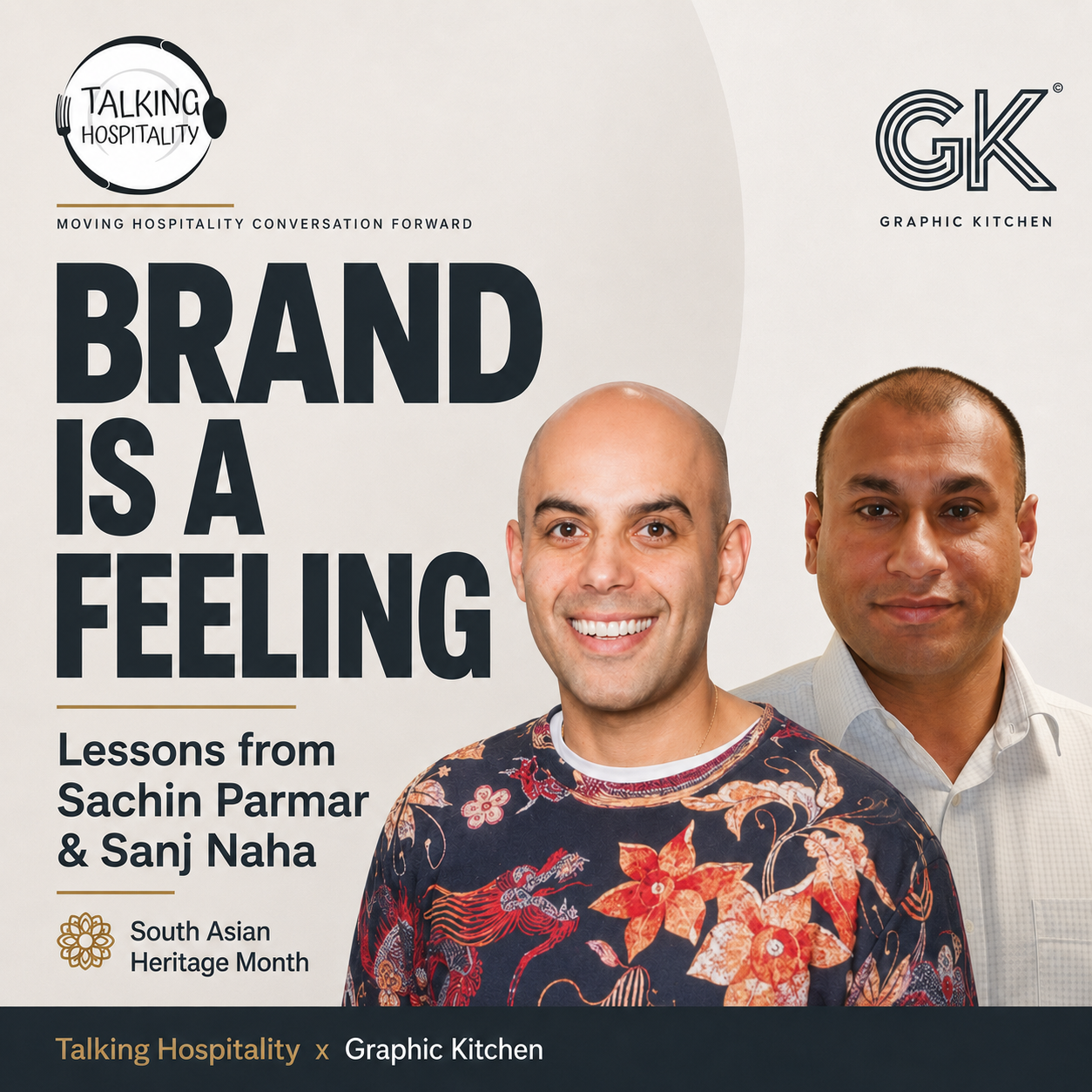
Brand is a feeling
Brand Isn’t the Logo. It’s the Reason People Come Back.
South Asian Heritage Month Series
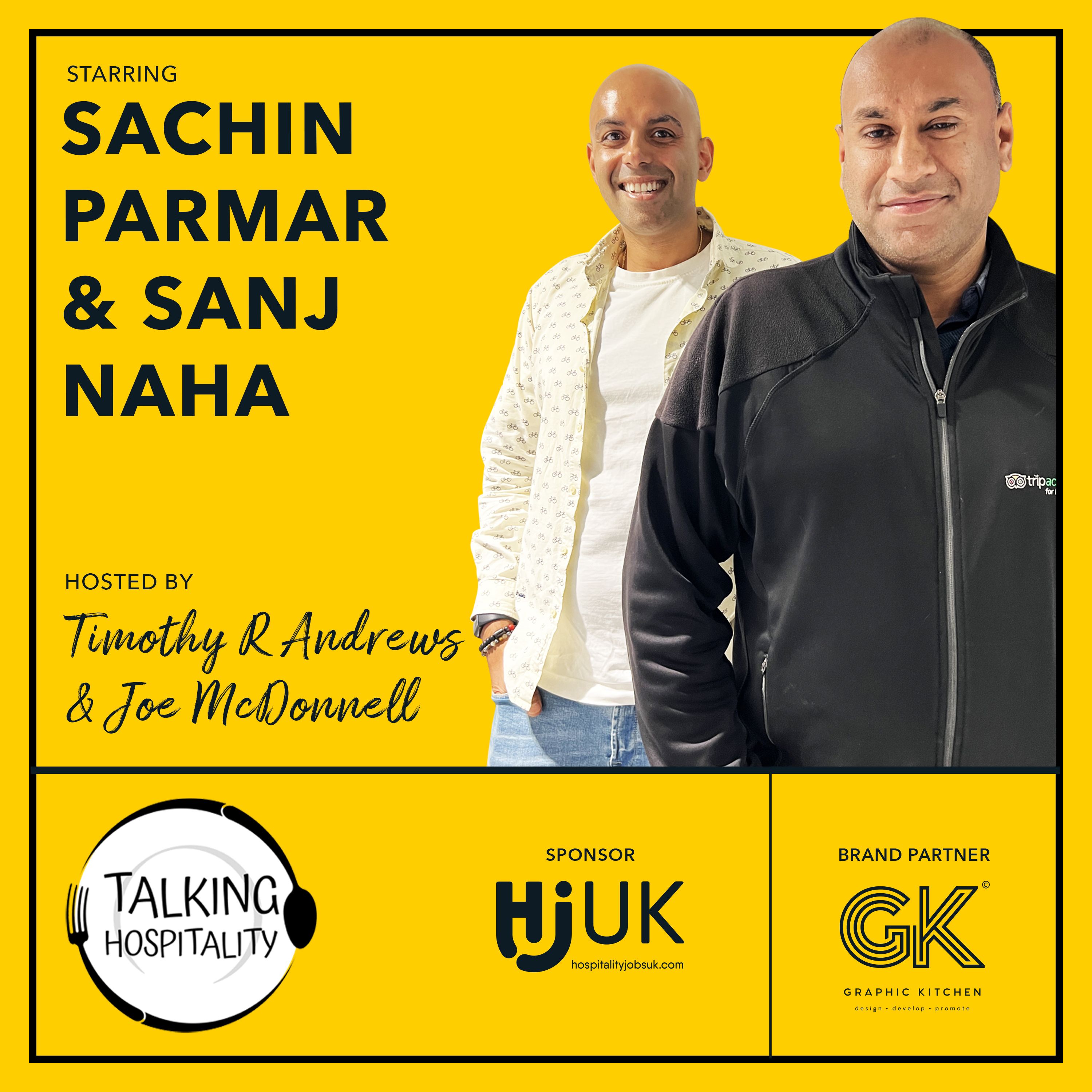
Featuring Sachin Parmar and Sanj Naha, Graphic Kitchen
South Asian Heritage Month is not an invitation for me to explain someone else’s lived experience.
That is not my place.
I am writing this as a white man who has spent his working life in hospitality, and my role here is simple: to listen properly, reflect honestly and use the Talking Hospitality platform to amplify voices from our industry.
That feels especially important this year. South Asian Heritage Month 2026 runs from 1–31 July, with the theme “Unity in Diversity”. The official purpose is to celebrate, commemorate and educate, while recognising the breadth of South Asian communities, histories and contributions across the UK.
For Talking Hospitality, that means doing something more meaningful than a quick celebratory post and a stock image.
It means going back to the conversations we have already had with South Asian leaders, founders and operators, then asking: what did they teach us?
Our conversation with Sachin Parmar and Sanj Naha from Graphic Kitchen is a strong place to start.
On the surface, this was an episode about branding.
But it was really about something much bigger: why people choose a hospitality business, why they come back, and why some businesses build real loyalty while others simply create noise.
As Sachin put it, “Branding is not just design, it’s a feeling.”
That one sentence is the whole article, really.
Hospitality has never been more exposed
Brand matters because hospitality has become brutally transparent.
A guest can discover you on Instagram, check your reviews, look at your website, fail to book, find a competitor, read their menu, watch a TikTok, and make a decision before anyone in your business knows they ever existed.
That is not theory. That is modern hospitality.
UKHospitality describes hospitality as the UK’s third largest employer, with 3.6 million people working in the sector. It is a huge part of the economy, but also a sector under real pressure. YouGov’s 2025 GB Dining Out Report found that nearly 38% of diners were eating out less than the year before, mainly because of rising costs and the need to save money.
So when people do go out, they are choosing more carefully.
They want value, but not just cheapness.
They want ease, but not blandness.
They want experience, but not theatre for the sake of it.
They want to feel that the business knows what it is doing.
That is where brand stops being a marketing exercise and becomes a commercial discipline.
The two questions that decide everything
Sanj brought the episode back to two questions every restaurant, hotel, bar, café and hospitality brand should be able to answer.
Why should I come to your restaurant or hotel?
And once I have been, why should I come back?
Simple questions. Uncomfortable questions.
The first one is about attraction. It is your positioning, your promise, your visibility, your reputation and your ability to stand out in a crowded market.
The second is about trust.
Did the experience match the promise?
Was the booking easy?
Did the team understand the offer?
Was the food or drink consistent?
Did the menu help or confuse?
Was the atmosphere right?
Did anyone care enough to notice the details?
Because that is what guests remember.
They may not remember the exact wording of your brand statement. In fact, I would be slightly worried if they did. But they will remember whether the experience felt coherent.
That is Sachin’s point. Brand is not just the logo, the colour palette or the menu layout. Those things matter, but only if they are connected to the guest journey.
If your Instagram looks premium but your booking process is painful, that is brand.
If your menu is badly written and your team have to translate it table by table, that is brand.
If you say you are sustainable but cannot show how, that is brand.
If your toilets let the whole experience down, that is also brand.
And yes, the episode did get into toilets. Quite rightly.
Hospitality leaders know the truth. The guest experience does not stop at the table. Toilets, menus, booking forms, allergy information, uniforms, lighting, hand towels, tone of voice, payment, follow-up and reviews all tell the guest whether the business is paying attention.
The glamorous bits get noticed first.
The neglected bits get remembered longest.
The menu is one of your hardest-working salespeople
One of Sachin’s sharpest observations was that too many operators spend heavily on interiors, then underinvest in the menu.
That should make a few people shift in their chairs.
The menu is not admin. It is not just a list of dishes. It is one of the most important commercial tools in the building.
It sells.
It reassures.
It guides.
It reduces pressure on the team.
It expresses the brand.
It helps the guest make decisions.
At a time when recruitment, training and labour costs remain serious challenges, that matters. A well-designed menu does not replace trained people, but it supports them. It makes it easier for the guest to understand the offer and easier for the team to deliver it with confidence.
Sachin’s point was not just about design. It was about the whole structure: dish names, descriptions, allergen clarity, pricing, photography, tone, layout and whether the menu actually reflects the concept.
That is where Graphic Kitchen’s sponsor value comes through naturally. This is not “make it pretty and hope for the best”. It is brand as operational clarity.
A good hospitality brand helps the business work better.
That is the difference.
Convenience is now part of the experience
Sachin also talked about technology as part of the brand ecosystem: Instagram, website, chatbot, booking journey and the ability to move a guest from interest to action without friction.
This is not about replacing hospitality with machines.
It is about not losing a guest before hospitality has the chance to happen.
According to takepayments’ UK Restaurant Report 2025, 54% of Brits prefer to book restaurant reservations online. Deloitte’s research on the future of restaurants also found that 40% of customers prefer to order directly from restaurant websites, while 55% still prefer to use the phone for service concerns.
That tells us something important.
Guests are not purely digital or purely traditional. They are practical.
They want the right channel for the right moment.
If they are trying to book a table quickly, online convenience matters. If something has gone wrong, they may still want a human conversation. The problem is not technology. The problem is badly designed technology that adds friction instead of removing it.
And this is where some hospitality businesses quietly lose revenue every day.
A guest is ready to book. The website is clunky. The phone is not answered. The booking widget is hidden. The menu is out of date. The Instagram link goes nowhere useful.
So they leave.
Not dramatically. Not angrily. No formal complaint. No big speech.
They just go somewhere else.
The most expensive lost guest is often the one you never knew was there.
Sanj’s story shows how far the industry has travelled
The most personal part of the episode came when Sanj spoke about his father.
His father opened the Taj Mahal in Ipswich in 1964, bringing Indian restaurant hospitality to that part of the East of England. Sanj described being a child in the restaurant, watching his father become the brand of the business and seeing the pressure he felt when there were empty seats on a Friday or Saturday night.
That story matters.
Not because it needs to be romanticised. Actually, the power of it is that it was not romanticised.
It was business.
It was risk.
It was family.
It was pressure.
It was reputation built without the tools we take for granted today.
No online booking platform. No Google profile. No Instagram. No TikTok. No email database. No automated review request. No paid social campaign quietly nudging people towards a table.
Yellow Pages, flyers, word of mouth and the lived experience of the guest.
That was the marketing mix.
Sanj’s father did not want him to go into restaurants. Many hospitality families will understand that contradiction. You can be proud of the industry and still know how hard it is. You can love the business and still hope the next generation has a different route.
Sanj’s own route took him through economics, management consultancy, hospitality technology, online reservations and TripAdvisor.
Different era.
Different tools.
Same fundamental challenge.
How do you get people through the door, give them an experience worth talking about, and make them want to return?
Reviews are not a nuisance. They are part of the sales journey
Sanj was especially clear on TripAdvisor and online reputation.
His advice to operators was blunt: take the emotion out of it.
That is easy to say when you are not the person reading a one-star review at 11.42pm after a double shift, but he is right.
Review platforms can be frustrating. They can feel unfair. Sometimes they are unfair. Every operator has a story about the guest who did not book, could not get in, and then punished the business online for being full.
But frustration is not a strategy.
BrightLocal’s 2026 Local Consumer Review Survey found that 97% of consumers read reviews for local businesses, and 85% are more likely to use a business after reading positive reviews. It also found that 89% of consumers expect business owners to respond to reviews.
That is why reputation can no longer sit in the “we’ll get to it when we have time” pile.
Reviews are now part of discovery.
They are part of SEO.
They are part of conversion.
They are part of trust.
Sanj also made the point that TripAdvisor still matters, even with the rise of Google, Instagram and TikTok. Tripadvisor says its Travellers’ Choice Awards are based on the quality and quantity of reviews and ratings collected over a 12-month period; its standard Travellers’ Choice award recognises businesses in the top 10% of listings.
In other words, reputation is not just a vanity metric.
It is public proof.
The real opportunity is to mobilise happy guests
One of Sanj’s most useful observations was that most guests are probably having a good experience. The issue is that happy guests often leave quietly, while unhappy guests are more motivated to post.
That creates a distorted picture.
The answer is not to obsess over every negative review until your soul gently leaves your body. The answer is to build a consistent habit of encouraging positive, genuine reviews from guests who have had a good experience.
BrightLocal’s research supports this: 94% of consumers are open to writing reviews, and 65% wrote one after being asked.
That is a practical opportunity hiding in plain sight.
Ask properly.
Make it easy.
Do it at the right moment.
Respond like a human.
Learn from the feedback.
Share the praise with the team.
Sanj also pointed out that when businesses improve their review performance, the benefits often ripple beyond TripAdvisor. They get more visibility, more bookings, more walk-ins and more positive mentions elsewhere. Team members start being named in reviews, which can build recognition, pride and healthy internal competition.
That last point is important.
Reputation is not only external.
It can strengthen culture inside the business too.
When a team member sees their name in a positive review, that matters. It says, “someone noticed”. In an industry where people can work incredibly hard and still feel unseen, that is not a small thing.
Purpose has to show up somewhere
Later in the conversation, Sachin defined brand through purpose, connection and consistency.
That is where the episode moved from marketing into leadership.
Purpose is easy to talk about. It is much harder to evidence.
If a restaurant says it is authentic, where does that authenticity show up?
If a hotel says it cares about people, do the team feel that?
If a brand says it is sustainable, can it prove it?
If the website promises warmth but the arrival experience feels cold, what is the guest supposed to believe?
Sachin’s argument was that everything has to connect: the food, the room, the service, the social media, the menu, the operations and the reason the business exists.
That is not fluffy. It is commercial.
Because disconnected brands create confused guests.
Confused guests do not tend to become loyal guests.
Hospitality is built in moments
Sanj described brand as something emotive. For him, it is about how people feel and the moments created during the experience.
That might be the way a host welcomes a regular.
The way a server reads a table.
The way a chef’s work is explained without making the guest feel foolish.
The way housekeeping notices a detail.
The way a manager handles a problem before it becomes a complaint.
The way a team member adds personality without going off-brand.
Those moments cannot all be scripted. Nor should they be.
But they can be understood, encouraged and designed into the culture of the business.
That is the leadership lesson here.
Brand does not live in the marketing department. It lives in the behaviour of the team.
And if the team do not understand it, the guest will not feel it.
What this conversation teaches us
For me, this episode with Sachin and Sanj is exactly why South Asian Heritage Month should not be reduced to surface-level celebration.
Food matters, of course.
Culture matters.
Representation matters.
But heritage also lives in enterprise, leadership, family businesses, creative work, technology, reputation and the daily graft of building something that lasts.
It lives in Sanj’s father opening a restaurant in Ipswich in 1964.
It lives in Sachin challenging operators to stop cutting corners and build proper brand foundations.
It lives in Graphic Kitchen helping hospitality businesses understand that design, story, operations and guest experience are not separate pieces of work. They are connected.
As someone outside that lived experience, I do not need to claim ownership of the story.
I need to listen well enough to pass on the lessons.
And the lessons here are clear.
Brand is not what you say.
It is what guests feel.
It is what the team understand.
It is what reviews reveal.
It is what the menu sells.
It is what the website enables.
It is what people remember after they leave.
At the end of the episode, Sachin shared a quote:
“To survive an impossible situation, you don’t need the reflexes of a Grand Prix driver, the muscles of Hercules or the mind of Einstein. You simply need to know what to do.”
Hospitality does not need more noise.
It needs clarity.
It needs businesses that understand who they are, what they promise and how that promise is delivered at every touchpoint.
Because brand is not the logo.
It is the reason people come back.
References
This article draws on the Talking Hospitality episode with Sachin Parmar and Sanj Naha from Graphic Kitchen.
South Asian Heritage Month 2026 runs from 1–31 July and uses the theme “Unity in Diversity”.

Founder & Host
Timothy R Andrews is the founder and host of Talking Hospitality, a UK hospitality podcast, media and learning platform for experienced industry leaders.
With more than 20 years’ experience in hospitality and recruitment, including 16 years running his own hospitality recruitment business, Timothy brings a strong people, leadership and talent perspective to the conversations he hosts.
Through Talking Hospitality, he explores the issues shaping the industry across People & Culture, Operations and Technology, bringing together operators, founders, people leaders and industry specialists to share experience, challenge assumptions and identify practical ways forward.
Alongside the podcast, Timothy works across hospitality media, events, training and learning, with a particular interest in leadership, career progression, inclusion, learning and development, and how new technology is changing the industry. He also wrote **Only A Pavement Away**, performed by Cameo Williams, supporting the hospitality charity Only A Pavement Away.
7 Mistakes You're Making with Hospitality Staff Retention (and How to Fix Them)