Why You Should Be Supporting Local Drag
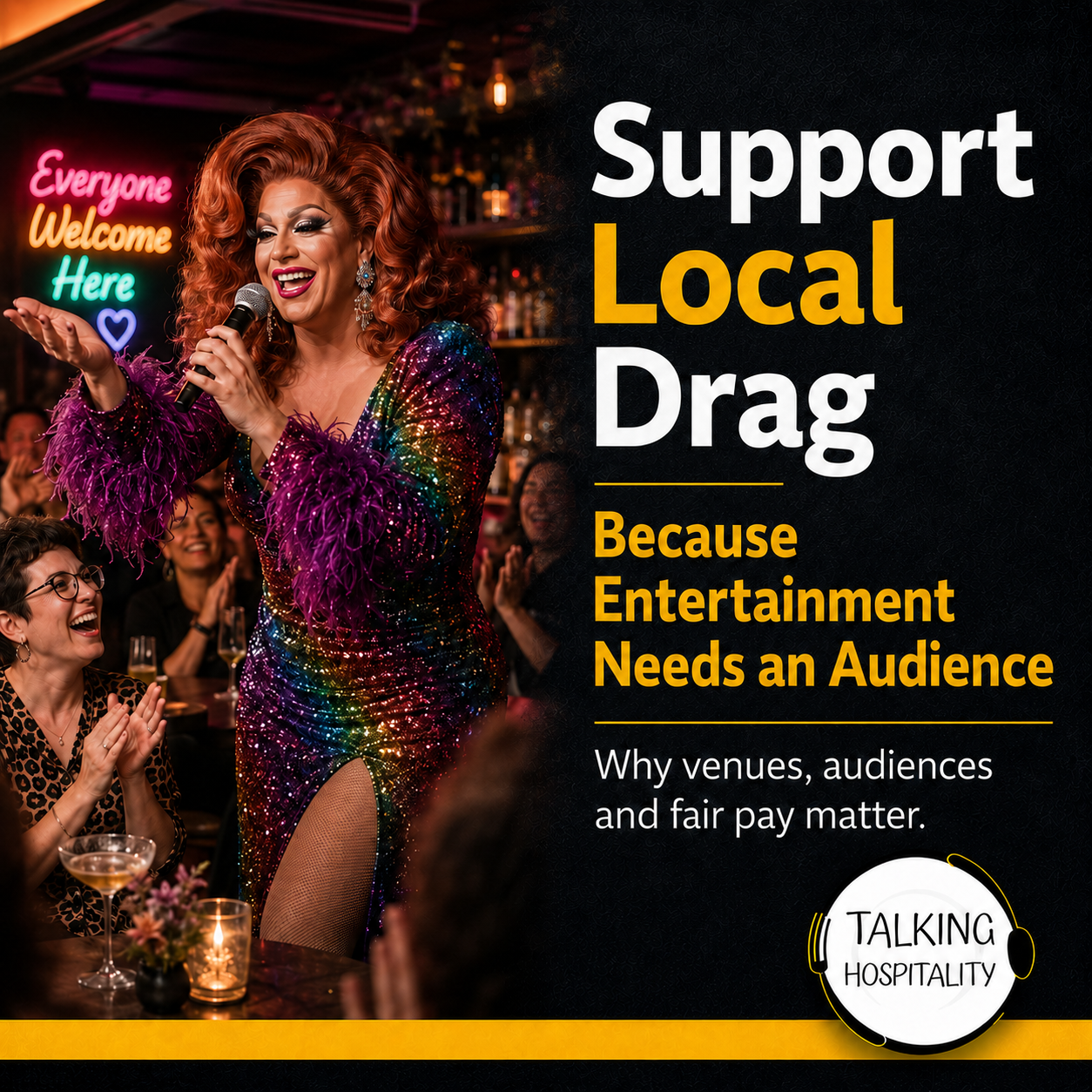
Support Local Drag
Here's Why
A companion piece to "What Can We Learn From Drag Queens?"
Drag is often treated as the loud bit of the night. The funny bit.
The eyelashes. The heels. The jokes. The song choice that starts as camp fun and somehow ends with half the room emotionally re-evaluating their life choices over a lukewarm prosecco.
And yes, drag can be outrageous, hilarious and gloriously chaotic.
But listen properly to drag performers and you hear something deeper.
Drag is work.
Drag is craft.
Drag is community.
Drag is resilience.
Drag is hospitality culture in a wig, with timing, nerve and a very clear lighting preference.
And local drag needs more than applause after the final number.
It needs audiences.
It needs venues.
It needs fair pay.
It needs safe spaces.
It needs proper promotion.
It needs respect.
In other words, darling, it needs more than a rainbow poster and a last-minute booking because someone remembered Pride Month starts on Saturday.
Drag did not “bounce back” by magic
During the pandemic, performers were hit hard.
Bars and clubs closed. Events vanished. Audiences disappeared overnight. For many drag performers, that meant losing not only income, but the live connection that sits at the heart of their work.
In our drag round table, the performers talked about digital shows, social media, green screens, online content, smoke machines with questionable timing, and doing what they could to keep people entertained while everyone was stuck inside.
There is humour in those stories. Of course there is. Drag can turn a disaster into a punchline faster than a general manager can say, “Who approved this rota?”
But underneath the humour was something serious.
Performers adapted quickly, often with very little safety net. They learned new platforms. They built content. They found audiences online. They kept showing up.
And audiences needed them.
During a bleak period, local entertainers helped people feel less alone. They gave people something to look forward to. They created connection from bedrooms, living rooms and makeshift studios.
That matters.
Drag belongs in hospitality
Drag has always had a natural home in hospitality.
Pubs, bars, cabaret rooms, restaurants, clubs, brunches, festivals, Pride events, community fundraisers and late-night venues have all been shaped by drag talent.
And not just LGBTQIA+ venues.
Drag has moved further into mainstream culture, but the local scene remains essential. A televised show might introduce someone to drag. A local venue makes them part of the culture.
That difference matters.
Local drag is where performers learn. It is where they test material, build confidence, find their voice, develop an audience and occasionally discover that a zip really should have been tested before showtime.
It is also where audiences experience something immediate and alive.
There is a different energy in a local venue. You are not watching from a sofa. You are in the room. You can feel the timing, the risk, the quick wit, the recovery when something goes wrong, and the sheer skill of holding a mixed crowd together.
Hospitality people should recognise that skill straight away.
Because a great drag performer is doing what great hospitality people do all the time: reading the room, managing energy, creating welcome, handling disruption, lifting the atmosphere and making people feel part of something.
Just with more lashes.
Why this matters now
This conversation feels even more urgent in 2026 because the spaces that support local entertainment are under real pressure.
Across the UK, late-night venues have been closing at a worrying rate. Grassroots performance spaces are still dealing with fragile margins, rising costs and changing audience habits. For performers, the picture is not much easier. Many nightlife artists are juggling low fees, insecure work, late-night travel, safety concerns and the constant pressure to market themselves as well as perform.
That matters for drag because local performers do not appear from nowhere, fully formed, perfectly contoured and ready to command a brunch crowd with one eyebrow.
They need places to learn.
They need rooms to work.
They need audiences to test material with.
They need venues that understand entertainment as a partnership, not a decorative extra.
When those spaces disappear, we do not just lose a night out. We lose part of the talent pipeline. We lose community infrastructure. We lose places where people can gather, perform, experiment, belong and be properly entertained.
And hospitality has a role in protecting that.
Not by saving the entire night-time economy single-handedly. Let’s not be dramatic. Most operators are already wrestling with costs, staffing, bookings and guests who still think “fully booked” is an opening negotiation.
But venues can make better choices with the spaces they do have.
They can programme thoughtfully.
They can pay fairly.
They can promote properly.
They can protect performers.
They can build repeat events rather than one-off gestures.
They can treat local entertainment as part of the business model, not a panic booking with a poster.
2026 audiences need a reason to leave the house
Here is the modern hospitality reality.
People are more selective about nights out. Disposable income is under pressure. Late-night venues are under pressure. Guests often want experiences that feel worth the effort, the spend, the travel and the inevitable internal debate about whether they should have stayed in with a takeaway.
So the question for venues is not just, “Should we book drag?”
The better question is: “Can drag help us create a night people genuinely want to attend, remember and recommend?”
The answer is yes, when it is done properly.
A well-run drag night can bring energy into a quiet daypart. It can turn a slow Sunday into a regular event. It can give guests a reason to bring friends. It can build loyalty with local communities. It can create social content that actually feels alive rather than another photo of a cocktail next to a houseplant.
Drag brunch, cabaret dinners, quiz nights, bingo, karaoke, supper clubs, charity events, Pride celebrations, staff parties, launch nights and community fundraisers can all work.
But here is the important bit.
You cannot just add a queen and hope the booking sashays into profitability by itself.
That is not programming.
That is glitter with a budget code.
“Use it or lose it” is not just a phrase
One of the strongest messages from the episode was simple: support local drag by going to see local drag.
That may sound obvious, but it needs saying.
Venues need audiences. Performers need bookings. Nights need bar spend. Communities need safe, joyful places where they can gather.
If people only support drag when it is attached to a famous name, a big TV franchise or a viral clip, the local pipeline weakens.
And once local venues go, they are very hard to replace.
Hospitality leaders know this already. A room is not just a room. A venue carries memory.
First nights out.
First performances.
First dates.
First chosen families.
First moments of feeling at home.
First time someone realises they are allowed to be louder, softer, stranger, funnier, bolder or more themselves than they thought.
When LGBTQIA+ venues and drag-friendly spaces disappear, communities lose more than entertainment.
They lose infrastructure.
That may sound like a serious word for a room with a mirrorball and a questionable cloakroom system, but it is true.
These spaces are part of the social fabric.
Respect the craft
Drag can look effortless when it is done well, which is deeply unfair because the amount of effort involved is often ridiculous.
There is costume, make-up, rehearsal, travel, music editing, hosting, audience management, comedy timing, emotional intelligence, improvisation, marketing and the ability to deal with someone in the front row who has mistaken “audience participation” for “main character audition”.
That is skill.
So venues need to treat drag as skilled work.
That means clear booking terms, fair payment, safe dressing spaces, proper promotion, respectful treatment from staff and a manager who understands that “it’ll be good exposure” does not pay for lashes, wigs, taxis or rent.
Exposure is very overrated when your electricity bill arrives with confidence.
If you are booking a performer, be clear about the basics:
What is the fee?
What time is call time?
What time is performance time?
How many sets are expected?
Who provides sound and tech?
Is there a microphone?
Is there a changing area?
Who is the manager on duty?
What happens if the event runs late?
How will the performer be promoted?
How will you handle guests who behave badly?
None of that kills the fun.
It protects the fun.
Pride Month booking is not enough
Drag and Pride have a natural connection. There is joy, protest, performance, visibility and community in both.
But venues need to be careful not to treat local drag as Pride Month confetti.
Booking drag once in June, underpaying the performer, failing to promote the night properly and then calling it “supporting the community” is not the serve some people think it is.
Support is year-round.
That does not mean every venue needs weekly drag programming. Not every concept, location or audience will suit it, and that is fine.
But if you are going to do it, do it properly.
Build a relationship with local performers. Ask what format works. Understand the audience. Plan the marketing. Brief the team. Pay on time. Follow up after the event. Book again when it works.
A one-off Pride booking might create a moment.
A proper partnership creates culture.
Make the event operationally sound
Hospitality leaders love an event until the practical details start waving from the corner like a distressed commis chef.
Drag events need operational planning.
Think about sightlines. Can guests actually see the performer, or will half the room spend the evening staring at the back of a pillar called Derek?
Think about sound. A performer without decent sound is not a vibe. It is a hostage situation with music.
Think about space. Is there room to move? Are servers trying to carry hot plates through the middle of a lip-sync number? Has anyone told the host that table 14 is also the runway?
Think about timings. Drag brunch may sound simple, but brunch has its own operational personality disorder. Food, drinks, service, performance and guest arrivals all need to work together.
Think about the team. Do staff know what is happening? Do they know who the performer is? Do they understand the event tone? Do they know how to handle inappropriate comments from guests?
Think about the guest journey. What does the booking confirmation say? Is the event clearly described? Are guests told if there will be audience participation, adult humour or loud music? Is there accessible seating? Are dietary needs still being handled properly, or has glitter briefly replaced operational discipline?
The best drag events feel spontaneous to the guest because someone has done the planning.
That is hospitality.
Protect the performer
This should be obvious, but let’s not rely on obvious. Obvious has failed our industry before, usually while wearing a name badge.
Performers need to feel safe in your venue.
That means they should have somewhere private to change if possible. They should know who the duty manager is. They should not have to negotiate harassment alone. They should not be touched without consent. They should not be expected to absorb abuse because “it’s part of the act”.
It is not part of the act.
Banter is not a licence for poor behaviour. Audience participation is not permission to grab, shout abuse or make personal comments. Funny does not mean available for nonsense.
The venue sets the standard.
A simple staff briefing before the event can make a huge difference:
“Tonight’s performer is part of the event team. Treat them professionally. If a guest behaves inappropriately, escalate it to the duty manager. Do not leave the performer to deal with it alone.”
That is not complicated.
That is basic leadership with better eyeliner.
Inclusion beyond the stage
Drag also gives hospitality leaders an opportunity to think more broadly about inclusion.
Who feels welcome in your venue?
Who performs there?
Who is protected there?
Who is represented there?
Who is allowed to be loud, expressive, different, funny, emotional, strange, brilliant and fully themselves?
Because drag often opens the door to bigger conversations about gender, identity, creativity, safety, disability access, British Sign Language interpretation, local arts and community care.
One of the most powerful moments in the episode was hearing about drag combined with British Sign Language and the impact that had on audiences.
That is where entertainment becomes something bigger.
Not worthy. Not dusty. Not “we have formed a committee and everyone is already tired.”
Just thoughtful.
A venue can ask: how do we make this event more accessible? Can people hear it? Can people see it? Can people move through the space safely? Do we offer seating options? Are we clear about content and timings? Are we welcoming to people who may be new to drag or new to LGBTQIA+ spaces?
Inclusion is not the glitter you throw on at the end.
It is part of the planning.
How audiences can support local drag
For audiences, the action is straightforward.
Go to local shows.
Take friends.
Buy a ticket.
Tip where appropriate.
Share the event.
Follow local performers.
Buy merchandise.
Post about the night.
Credit performers properly.
Respect boundaries.
Do not touch performers without consent.
Do not film everything unless filming is clearly welcomed.
Remember that “funny” does not mean “here to be heckled by someone two cocktails past wise”.
If you enjoy drag, support it in real life.
Streaming clips is fine. Watching TV is fine. Quoting “sashay away” at every available opportunity is between you and your conscience.
But local drag survives when people turn up.
How venues can support local drag
For venues, the action is practical.
Book local talent.
Pay properly and promptly.
Agree terms in advance.
Promote the event properly.
Brief the team before the night.
Provide a safe changing area where possible.
Protect performers from abuse.
Make the event accessible where you can.
Use good photography and credit performers.
Build repeat events, not one-off gestures.
Review what worked afterwards.
The commercial opportunity is real.
Drag can bring people into venues, create energy, increase dwell time, build community loyalty and give guests something to talk about. It can help a venue feel alive.
But the relationship has to be mutual.
A venue should not see drag performers as decoration. Performers are partners in the guest experience.
Treat them that way.
A quick checklist before booking a drag event
Before you press publish on the event poster, ask:
Have we agreed the fee, timings and number of sets?
Have we confirmed payment date and method?
Have we agreed what promotion the venue will do?
Have we given the performer key venue details?
Have we checked sound, microphone and performance space?
Have we thought about dressing space and privacy?
Have we briefed the duty manager and team?
Have we planned how to handle poor guest behaviour?
Have we considered accessibility and seating?
Have we made the booking page clear for guests?
Have we agreed whether filming and photography are okay?
Have we planned a proper follow-up after the event?
That is not overthinking.
That is good event management.
And if there is one thing hospitality knows, it is that the best fun usually has a clipboard hiding somewhere backstage.
Local drag keeps hospitality interesting
Hospitality is at its best when it brings people together.
Not just to eat, drink or stay, but to feel part of something. A good venue can become a meeting place, a memory maker, a local institution and occasionally the setting for decisions made after two margaritas that nobody’s group chat will ever forget.
Drag belongs in that story.
It brings joy, theatre, wit, resilience, community and a level of commitment to costume that frankly puts most “smart casual” dress codes to shame.
But it needs support.
Not just during Pride Month.
Not just when a famous name is attached.
Not just when the marketing calendar needs a splash of colour.
Local drag needs people in rooms.
It needs venues that book properly.
Audiences that show up.
Managers that protect performers.
Operators that understand the value of culture.
Hospitality leaders that can see entertainment as more than a nice extra.
Because when drag is supported well, everybody benefits.
The performer gets paid.
The venue gets energy.
The audience gets joy.
The community gets space.
Hospitality gets a little more alive.
And really, isn’t that the whole point?
Listen back to our drag round table with Mary O'Kart, Stephanie Von Clitz and Linda Barcardi.
Then go out and support the local performers keeping hospitality spaces alive, joyful and properly interesting.

Founder & Host
Timothy R Andrews is the founder and host of Talking Hospitality, a UK hospitality podcast, media and learning platform for experienced industry leaders.
With more than 20 years’ experience in hospitality and recruitment, including 16 years running his own hospitality recruitment business, Timothy brings a strong people, leadership and talent perspective to the conversations he hosts.
Through Talking Hospitality, he explores the issues shaping the industry across People & Culture, Operations and Technology, bringing together operators, founders, people leaders and industry specialists to share experience, challenge assumptions and identify practical ways forward.
Alongside the podcast, Timothy works across hospitality media, events, training and learning, with a particular interest in leadership, career progression, inclusion, learning and development, and how new technology is changing the industry. He also wrote **Only A Pavement Away**, performed by Cameo Williams, supporting the hospitality charity Only A Pavement Away.
Student and Seasonal Worker Onboarding: Does Your Process Work?