Probation and Unfair Dismissal in Hospitality: What Changes?
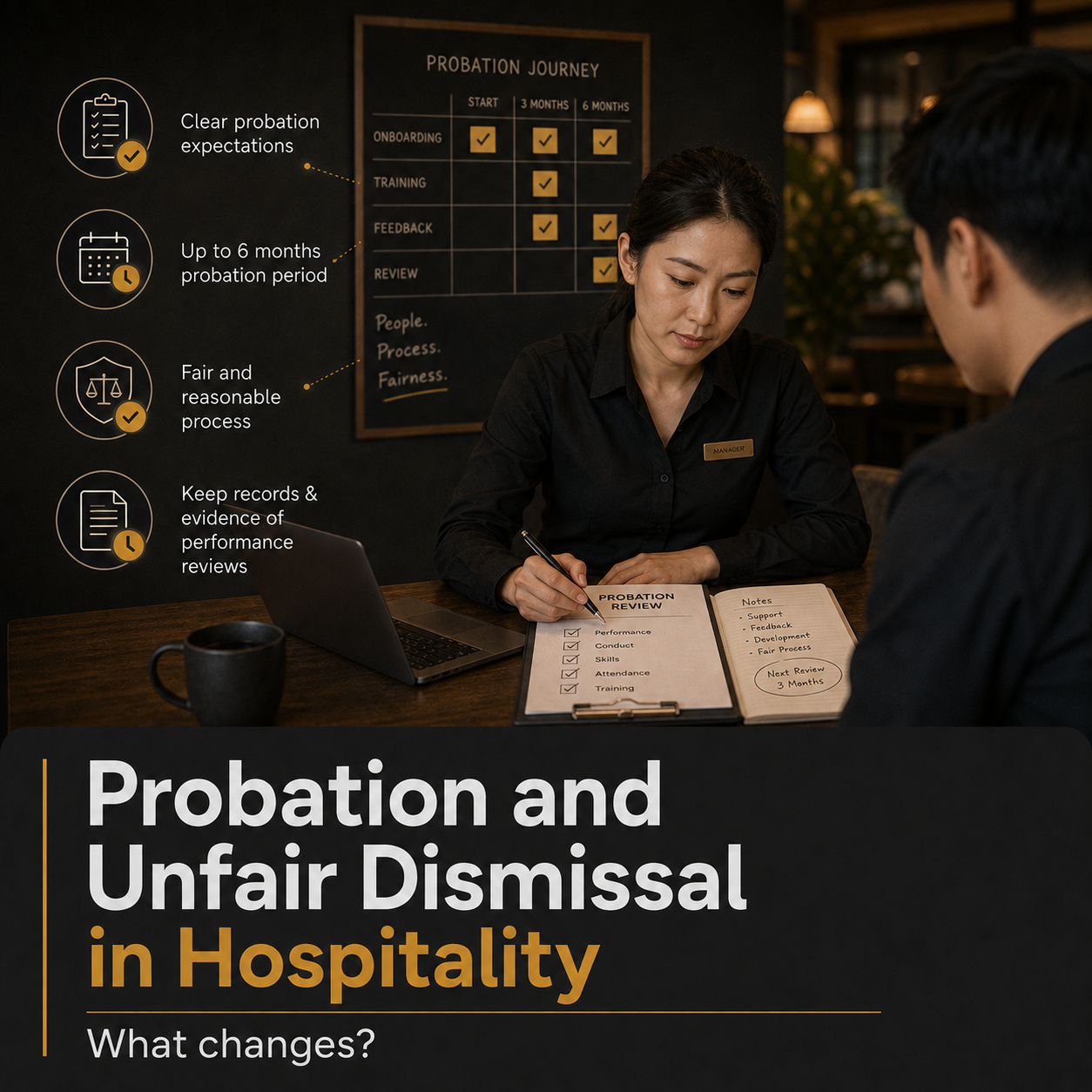

If probation is meant to be a period of support and assessment, what changes when ordinary unfair dismissal protection arrives much sooner?
For hospitality employers across England, Scotland and Wales, the answer is not that every new starter becomes impossible to manage. Nor does it mean a probation period suddenly becomes meaningless.
It means we need to be more deliberate.
From 1 January 2027, the qualifying period for ordinary unfair dismissal protection is due to reduce from two years to six months under the Employment Rights Act 2025. The qualifying period for an employee’s right to request written reasons for dismissal will also reduce to six months, and the current cap on compensatory awards for unfair dismissal is due to be removed.
That is a significant shift for hospitality businesses, particularly those recruiting large numbers of people, managing seasonal peaks or relying on busy operational managers to make quick decisions.
But here’s the important bit: a shorter qualifying period does not remove an employer’s ability to assess suitability, manage capability, address misconduct or dismiss someone fairly.
It makes the quality of the process matter more.
Probation is a management process, not a legal safe zone
A hospitality probation period should give both sides a realistic opportunity to test the employment relationship.
Can the team member meet the standards of the role? Do they understand the operation? Can they work safely, reliably and respectfully with colleagues and guests? Are they receiving the training and support they need?
And, just as importantly, is the job what was promised during recruitment?
Probation is not a magical legal bubble where normal responsibilities disappear. Employees already have important day-one protections, including protection against discrimination and automatically unfair dismissal for certain reasons. Those protections remain separate from the new six-month qualifying period.
So, dismissing someone during probation is not automatically risk-free. Saying “they were still on probation” will not answer a discrimination allegation, a claim involving whistleblowing or health and safety, or an argument that the employer acted for an automatically unfair reason.
Probation is also not a substitute for good leadership. If someone has had two shifts, no proper induction and contradictory instructions from three different supervisors, it is difficult to call their performance fairly assessed.
That is not probation. That is throwing someone into the deep end and then criticising them for getting wet.
What is changing from January 2027?
The official position is that, for dismissals with an effective date on or after 1 January 2027, ordinary unfair dismissal protection will generally apply after six months’ continuous service rather than two years.
The government’s implementation approach is expected to extend protection immediately to employees who already have at least six months’ service on that date, with others gaining protection once they reach six months. Transitional rules and official guidance remain important, particularly where notice periods, fixed-term contracts or the effective date of termination are involved.
The changes apply to England, Scotland and Wales. Northern Ireland is excluded from this specific framework because employment law relating to unfair dismissal is devolved there.
The Business Growth Service guidance on unfair dismissal rights confirms that employers will still be able to dismiss for legitimate reasons, including poor performance, provided the decision is fair and a suitable process is followed.
The Department for Business and Trade factsheet also makes clear that the calculation of compensation is not changing, but the cap on compensatory awards is due to be removed.
That does not mean every claim will produce a huge award. The government says most existing awards are well below the current cap. But removing the cap increases the potential exposure in some cases, particularly where a claimant has significant actual or projected losses.
For operators, this is not a reason to stop recruiting. It is a reason to stop treating people processes as paperwork that can wait until things go wrong.
Start before the first shift
Good performance management begins during recruitment.
What exactly did the advert promise? What did the manager say in the interview? Does the job description accurately reflect the role, or does it describe a calm daytime position while the reality is late-night closes, split shifts and constant customer contact?
If the expectations do not line up, the probation problem may have started before the employee walks through the door.
Before a new starter begins, review:
- The job description and key responsibilities.
- The hours, shift patterns and availability expectations.
- The skills or experience genuinely required.
- The service, safety and conduct standards.
- The training and induction that will be provided.
- How progress will be reviewed.
- What happens if more time or support is needed.
This matters for hospitality staff retention as well as legal risk. People are more likely to stay when the job matches the promise, the standards are clear and feedback is not delivered as a surprise ambush at the end of month three.
Make standards measurable and human
“Be better with guests” is not a useful performance standard.
“Follow the booking and allergy procedure on every shift, ask for support when unsure and use the agreed welcome steps during service” is much clearer.
The same applies to attendance, teamwork and conduct. You do not need a giant corporate competency framework. You do need enough clarity for a reasonable person to understand what good looks like.
Depending on the role, probation standards might include:
- Arriving ready for work at the agreed time.
- Following food safety, licensing and health and safety procedures.
- Completing required training.
- Using the till, booking system or operational tools correctly.
- Communicating respectfully with guests and colleagues.
- Responding appropriately to feedback.
- Working effectively during busy services.
- Asking for help rather than hiding mistakes.
- Meeting role-specific sales, service or production expectations.
The point is not to reduce people to numbers. It is to avoid vague judgments that later become difficult to explain.
A phrase such as “not the right fit” may be perfectly understandable in everyday conversation. On its own, though, it is weak. Fit for what? Which expectations were not met? Was the person told? Were they given a chance to improve? Were other employees treated consistently?
If the real issue is capability, say so. If it is conduct, identify the conduct. If the problem is availability, check that the decision is not connected to a protected reason or an inconsistent application of the contract.
Clear language is kinder than coded language.

Replace the surprise decision with regular check-ins
A six-month probation should not mean six months of silence followed by: “Unfortunately, it’s not working out.”
Schedule check-ins early and regularly. For example:
- End of week one: Is the induction working? Does the employee understand the basics?
- End of month one: What is going well? What needs attention?
- Around month three: Are the core standards being met? Is further support needed?
- Around month four or five: Is the person on track for confirmation, extension or a formal capability process?
- Before six months: Has a properly considered decision been made, with the relevant process followed?
Keep records of the conversation, not just the conclusion. Note what was discussed, what support was offered, what improvement was expected and when it would be reviewed.
This does not need to become a novel after every shift. A short, factual record is often enough.
“Late twice, discussed on 12 May. Employee explained transport issue. Shift start reviewed and earlier rota notice agreed. Review on 26 May.”
That is far more useful than “attendance not great”.
Support comes before a fair decision
If performance is below standard, ask what is behind it.
Has the employee been trained properly? Are they being moved between sections without enough guidance? Are managers giving conflicting instructions? Is there a language, literacy or confidence issue? Is there a health condition or disability requiring reasonable adjustments?
Reasonable adjustments may be relevant during probation just as they are at any other stage of employment. Do not assume a short length of service means an employee can be dismissed without considering support or adjustment.

If the concern is capability, set out the gap and provide a reasonable opportunity to improve. That might include additional shadowing, refresher training, clearer station responsibilities, more frequent supervision or a revised review date.
If the concern is misconduct, investigate before reaching a conclusion. Give the employee a fair opportunity to respond. Serious allegations may require a disciplinary process, even if the person is still within probation.
The exact process will depend on the facts, the contract, the employer’s policies and the seriousness of the issue. But the basic leadership principle is simple: do not make a dismissal decision first and search for a reason afterwards.
Extensions, capability and dismissal
An extension can be useful where someone is making progress but needs more time to demonstrate consistency. It should not be used as an indefinite holding pattern.
If you extend probation, confirm:
- The reason for the extension.
- The new end date.
- The standards still to be met.
- The support and training available.
- The review dates.
- What may happen if the required improvement is not achieved.
Be especially careful with probation clauses that automatically extend beyond six months. A longer contractual probation does not postpone ordinary unfair dismissal protection. An employee may remain in probation while already having the right to challenge an unfair dismissal.
The government’s stakeholder roundtable summary reflects the concern that employers need practical guidance on performance management and dismissal. That guidance, and future case law, will matter. For now, operators should work from clear reasons, fair treatment, consistency and good records.
The hospitality sector has already raised concerns about the operational burden. The Morning Advertiser reported operators describing the reforms as a “field of landmines”, while a later article reported that hospitality welcomed the revised six-month approach as more pragmatic than day-one ordinary unfair dismissal protection. Both perspectives are worth taking seriously.
The answer cannot be “ignore the change”. Nor can it be “turn every supervisor into an employment lawyer”. It is better training, clearer systems and earlier conversations.
A practical six-month readiness plan

Before the employee starts
Review the advert, job description, contract and probation clause. Make sure the role’s reality matches the promise. Prepare an induction plan and identify who owns the employee’s development.
Weeks one and two
Cover safety, service, conduct, systems and practical expectations. Check understanding rather than assuming attendance equals learning. Record any immediate concerns and deal with them early.
Month one
Hold the first structured review. Ask what the employee needs from the business as well as what the business needs from them. Confirm priorities in writing.
Months two and three
Track progress against role-specific standards. Provide coaching, feedback and any reasonable adjustments. If there is a capability concern, explain the gap clearly and give the employee a fair opportunity to respond and improve.
Months four and five
Decide whether the employee is on track, needs a defined extension or requires a formal capability or disciplinary process. Do not wait for the final week to discover that nobody knows what is happening.
Before six months
Review the evidence and make a properly reasoned decision. If dismissal is being considered, check the reason, the evidence, the process, consistency and any protected-rights risks. Seek independent employment advice where appropriate.
That is good hospitality leadership, regardless of the legislation.
The bigger opportunity
There is a risk that the Employment Rights Act 2025 becomes another compliance burden piled onto already stretched operators. That concern is real. Small businesses may not have an HR team, and a busy general manager cannot spend every afternoon writing policy documents.
But there is also an opportunity here.
A better probation process can improve recruitment quality, reduce avoidable turnover and strengthen hospitality workplace culture. It can help managers spot training needs before frustration takes over. It can give new starters a fairer chance to succeed instead of leaving them guessing whether they are doing a decent job.
Probation should not be a trapdoor.
It should be a properly managed bridge between recruitment and long-term employment. From 2027, that bridge needs stronger handrails.
General information only: This article is intended as general information for hospitality employers and people professionals. It is not legal advice and does not replace advice on a specific situation. The Employment Rights Act 2025, commencement arrangements, transitional rules, official guidance and future case law may affect how these changes operate in practice. Employers should take independent professional advice before making significant employment decisions. Northern Ireland is excluded from the specific Great Britain framework described above.
Further reading:
- GOV.UK Business Growth Service: Unfair dismissal rights
- Department for Business and Trade: Unfair Dismissal factsheet
- GOV.UK: Summary of stakeholder roundtables on unfair dismissal changes
- Morning Advertiser: ‘Field of landmines’ : operators warn over Employment Rights reforms
- Morning Advertiser: Hospitality welcomes ‘pragmatic’ change to unfair dismissal plans
- Talking Hospitality: What does HR really do in hospitality?
- Talking Hospitality: What makes people stay in hospitality jobs?
- Talking Hospitality: Can hospitality recruitment survive another crisis?
7 Mistakes You're Making with Hospitality Staff Retention (and How to Fix Them)