Employment Rights Act 2025: A Hospitality Employer Checklist

This is the fifth and final article in our five-part series on the Employment Rights Act 2025.
We’ve already looked at guaranteed hours and rotas, Statutory Sick Pay, probation and unfair dismissal, and the responsibilities employers have around sexual harassment and whistleblowing. This final piece is about joining the dots.
Because employment reform is arriving in stages , but hospitality employers cannot prepare in stages if their people experience the workplace every day.
A team member does not experience “phase one” on Monday and “phase two” six months later. They experience the rota, the manager, the payslip, the sick-day conversation and the way concerns are handled. That is where the rubber meets the road.
So here is a practical hospitality employer checklist, split into what to check now, what to prepare next and what to keep monitoring.
> Important: This article provides general information, not legal advice. Implementation dates, regulations and official guidance can change. Check the latest information from GOV.UK, Acas, HMRC and a qualified legal or employment adviser before making decisions.
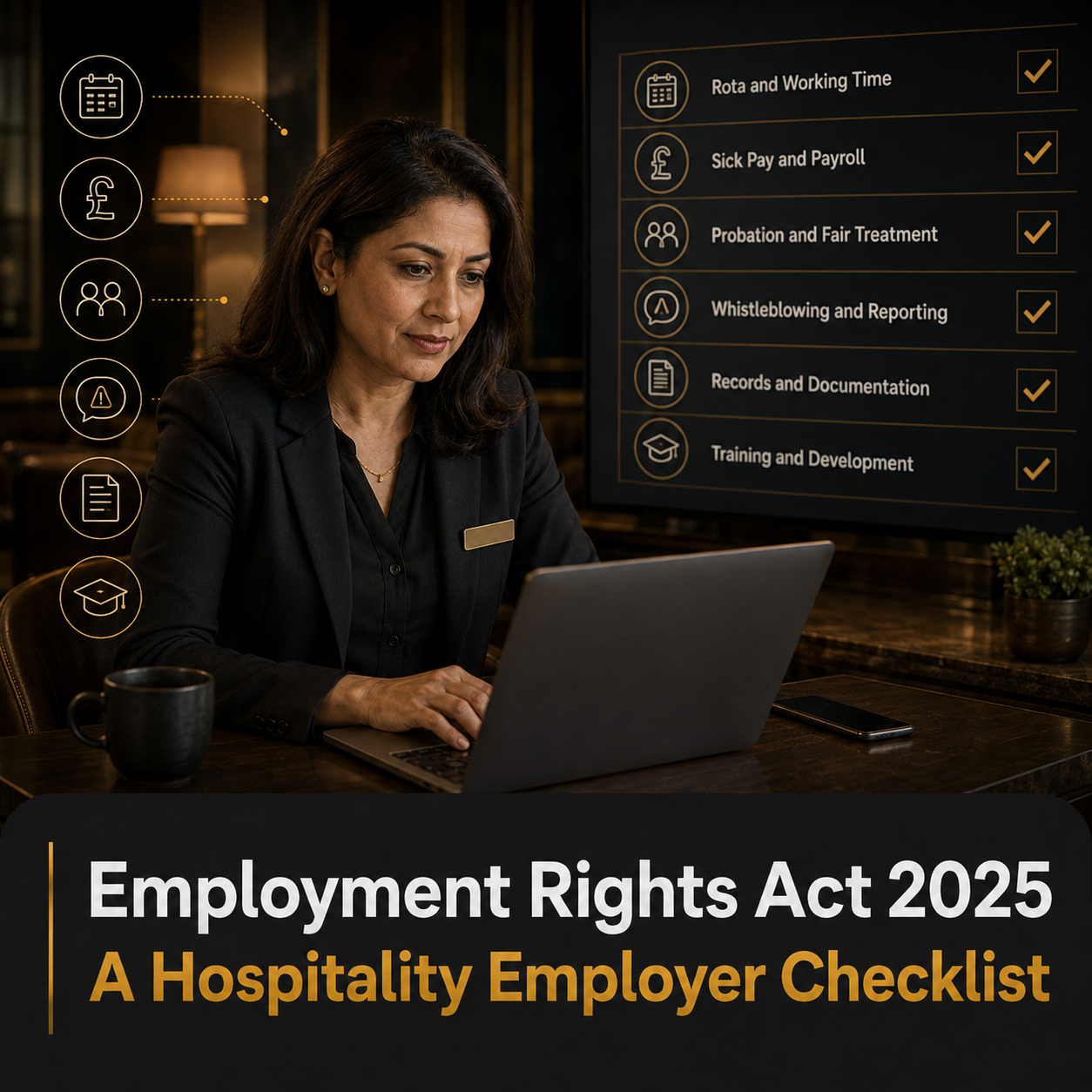
The one-page readiness checklist
That is the checklist. Now let’s put some context around it.
Check now: what should already be on your agenda?
1. Make SSP a payroll and rota priority
From 6 April 2026, SSP changes removed the Lower Earnings Limit and the waiting period. Eligible employees can qualify from the first day of sickness, including people who may previously have fallen outside the old earnings threshold.
For hospitality, this matters because the workforce often includes part-time employees, casual staff, students and people working varied weekly hours.
Ask your payroll provider:
- Is SSP being calculated correctly from the first qualifying day?
- Are low-paid employees being assessed under the new rules?
- Are managers recording sickness promptly enough for payroll to act?
- Do casual and irregular workers appear correctly in the system?
Your absence policy, manager guidance and return-to-work process should all match what payroll is actually doing. There is little point having a polished policy if a supervisor tells a team member, “You don’t get sick pay until day four.” That creates confusion, mistrust and potentially an expensive correction later.
Read the Business Growth Service employer guidance on Statutory Sick Pay and the relevant GOV.UK factsheets.

2. Make speaking up safe in practice
From 6 April 2026, protections were strengthened for workers who make whistleblowing disclosures about sexual harassment.
From 30 October 2026, employers will also be required to take “all reasonable steps” to prevent sexual harassment and will have obligations relating to harassment by third parties.
For hospitality, third-party risk can include customers, contractors, suppliers, agency workers and guests. A policy sitting in a shared drive will not be enough.
Check:
- Can every employee explain how to report a concern?
- Is there more than one reporting route?
- Do managers know what to do when someone raises an issue informally?
- Are investigations handled confidentially and consistently?
- Do rota decisions, section allocations and hours remain free from retaliation?
- Are harassment risks reviewed across late-night work, lone working, events, changing rooms and customer-facing roles?
The Business Growth Service harassment guidance is a useful starting point. The GOV.UK timeline sets out the current implementation position.
This is also a culture test. If people believe that raising a concern will quietly damage their shifts or reputation, the policy is decorative. And decorative policies do not protect teams.
3. Get your records in order
Good records are not about building a bureaucratic fortress. They are about being able to explain what happened, when it happened and why a decision was made.
Review how you store:
- contracts and written statements;
- rotas and actual hours worked;
- sickness and leave records;
- holiday entitlement and holiday pay;
- probation reviews;
- performance conversations;
- complaints, grievances and investigations;
- training attendance;
- changes to shifts, hours or working arrangements.
The government guidance says employers must keep adequate records to demonstrate compliance with holiday-pay and entitlement rules, with records retained for six years from the date they were made.
If your records are spread across WhatsApp, paper notebooks, spreadsheets and someone’s memory, now is the time to improve the system.
Prepare next: the work to complete before 2027
4. Treat probation as a genuine management process
From 1 January 2027, the ordinary unfair-dismissal qualifying period is planned to reduce to six months. The compensatory award cap will also be removed.
That does not mean every dismissal becomes impossible. It does mean that “they just weren’t right” is not a sufficiently robust management process.
Build a probation journey with:
- clear role expectations;
- documented objectives;
- an early check-in;
- a midpoint review;
- support or training where appropriate;
- a final review before the probation decision;
- a clear record of the reason for the outcome.
This is not about turning a pub, restaurant or hotel into a call centre. It is about avoiding rushed decisions made after a bad shift, a personality clash or a manager’s vague impression.
The GOV.UK unfair dismissal factsheet and Business Growth Service guidance should be checked as the detail develops.
5. Audit flexible work before the law catches up
The consultation on ending one-sided flexibility proposes rights relating to:
- guaranteed hours based on hours worked during a reference period;
- reasonable notice of shifts and changes;
- compensation when shifts are cancelled, curtailed or moved at short notice.
These measures have not yet taken effect, and detailed regulations and timings remain subject to consultation. The current consultation closes on 25 August 2026. Read the official zero-hours and similar contracts consultation.
Do not wait for the final regulations before looking at your data.
Ask:
- Which employees work a regular pattern despite having zero-hours or low-hours contracts?
- How often are shifts cancelled or changed?
- How much notice do people usually receive?
- Which venues rely on last-minute cover?
- What would guaranteed hours mean for labour budgets?
- Are agency workers part of the same operational dependency?
- Do employees want more certainty, or do some genuinely value flexibility?
This is where hospitality leadership needs nuance. Flexibility must work both ways. Some people need variable hours around study, childcare or another job. Others are exhausted by never knowing whether they will earn enough next month.
The goal is not to eliminate flexibility. It is to stop unpredictability becoming somebody else’s financial problem.
Keep monitoring: the wider employment picture
The Employment Rights Act 2025 is broader than the four main themes in this series. Hospitality employers should keep an eye on:
- Paternity Leave and Unpaid Parental Leave: these became day-one rights from April 2026, so contracts, payroll and manager knowledge should already reflect that.
- Holiday-pay compliance: retain accurate records and monitor the government’s consultation on compliance and enforcement.
- Trade-union duties: new requirements include informing workers of their right to join a union, alongside changes concerning access and representatives.
- Tipping: further strengthening of tipping law is expected by the end of 2026. Make sure your process is transparent and your team understands how tips and service charges are handled.
- Fair Work Agency enforcement: the agency was established in April 2026. Clean records and consistent processes matter more in an environment with simpler enforcement routes.
- Family, bereavement and flexible-working rights: further changes are expected during 2027.
The Business Growth Service overview is a useful central reference because it is being updated as measures come into force.
A 30/60/90-day preparation plan
Within 30 days
Owner-operator: appoint one person to coordinate the employment-rights plan.
HR or external adviser: review SSP, whistleblowing, harassment, family-leave and absence policies.
Payroll: test SSP calculations and confirm holiday-pay and record-retention arrangements.
Venue managers: brief supervisors on sickness reporting, respectful conduct and escalation routes.
Within 60 days
HR: introduce a consistent probation and performance-review template.
Venue managers: audit rota notice, cancellations, actual hours and zero-hours patterns.
Finance: model the likely cost of SSP, leave, administration and potential shift compensation.
Owner-operator: review recruitment and induction so new starters understand their rights and reporting options from day one.
Within 90 days
Leadership team: agree what employment model best supports each venue and workforce group.
HR and external adviser: review disciplinary, grievance and dismissal processes before January 2027.
Finance and operations: test different guaranteed-hours scenarios against demand, seasonality and labour budgets.
All managers: complete practical training and demonstrate that they can handle a sickness absence, complaint, whistleblowing disclosure and probation concern appropriately.

Questions for your next leadership meeting
Take these into the room:
- Where are we relying on informal knowledge rather than a reliable process?
- Which managers need support before they are expected to manage new rights?
- Do our rotas provide flexibility, or simply pass uncertainty to employees?
- Could a team member raise a concern without fearing fewer shifts?
- Are our records good enough to explain a decision six months from now?
- Which employment-rights change creates the greatest operational risk for our business?
- What would improve retention even if no law required us to do it?
- Are we recruiting people into jobs we can realistically support and manage well?
Compliance is operational resilience
It is tempting to see employment law as another cost, another deadline and another admin burden. Hospitality businesses are already dealing with enough pressure.
But the alternative is not “no process”. The alternative is inconsistent decisions, avoidable disputes, managers losing confidence and good people quietly walking out the door.
Strong hospitality HR compliance can improve recruitment and retention because candidates notice whether a business appears organised, fair and honest. Clear rotas help people plan their lives. Proper sick-pay processes make absence conversations less adversarial. Better manager training creates a more reliable hospitality workplace culture.
That does not remove the pressure of running a venue. It gives your team a stronger operating system for dealing with it.
As we’ve explored throughout this series, the question is not simply, “What do we have to do to comply?”
A better question is: What kind of workplace are we building, and are our systems honest enough to support it?
For more practical conversations on hospitality leadership, staff retention, HR, culture and the future of the industry, explore Talking Hospitality’s wider insight and podcast content.
Further reading
- Business Growth Service: guidance for employers
- Business Growth Service: new employment rights overview
- GOV.UK: Employment Rights Act 2025 timeline update
- GOV.UK: Employment Rights Act 2025 factsheets
- Morning Advertiser: operators warn over Employment Rights reforms
- Morning Advertiser: legal changes for pubs in 2026
- GOV.UK: consultation on ending one-sided flexibility

Tips, Service Charges and Tronc: What Is the Difference?