Trans Inclusion in Hospitality
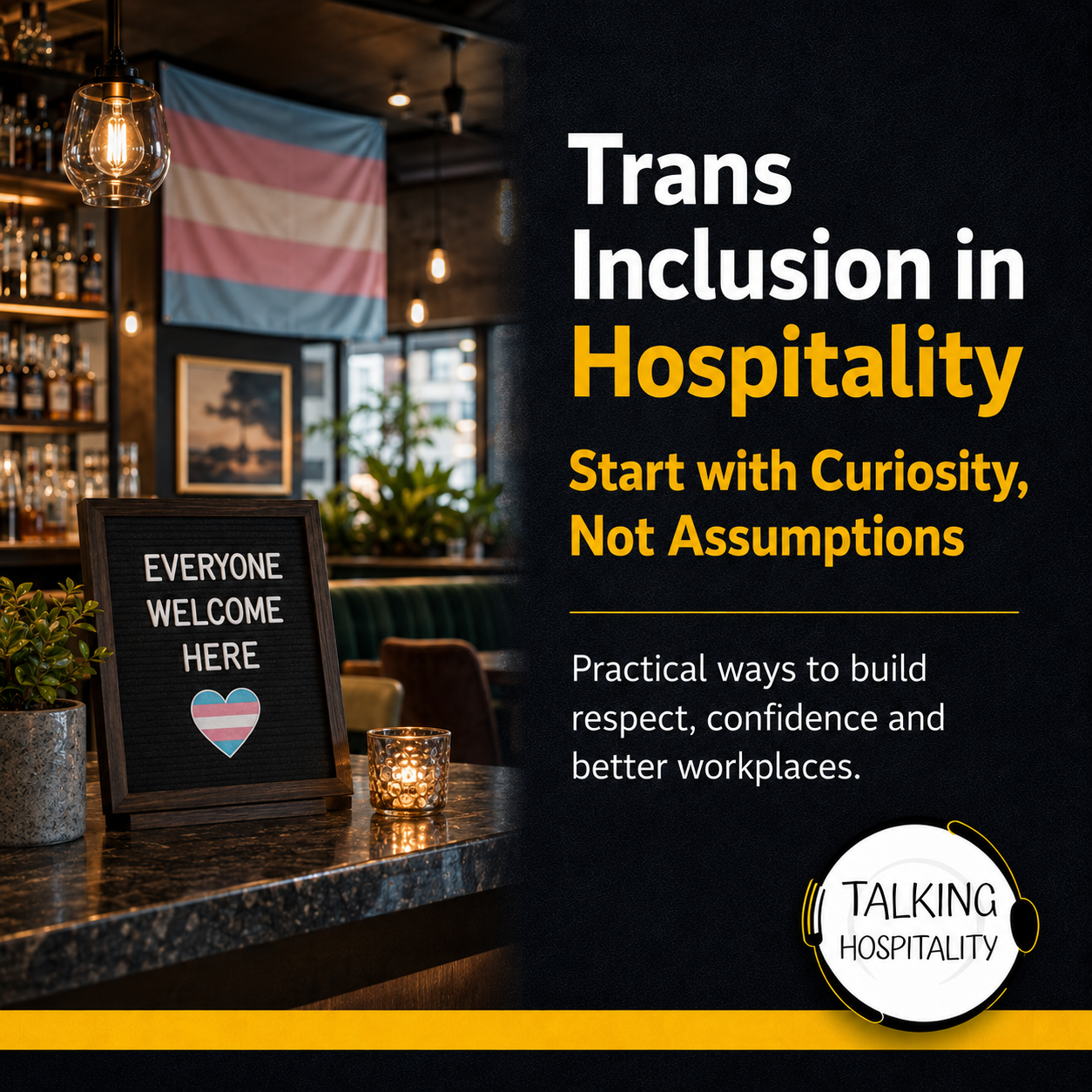
Trans Inclusion in Hospitality
Start with Curiosity, Not Assumptions
(Companion to: Trans and gender episode with Che Young
Gender. Trans. Pronouns. Identity.
For some hospitality leaders, those words are familiar. For others, they can feel like a conversation they are slightly nervous to enter. Not because they do not care, but because they do not want to get it wrong, say the wrong thing, or end up managing a situation they do not fully understand.
That is understandable.
The world has moved quickly. Language has changed. The legal landscape has changed. Younger team members are often more open about identity than previous generations were ever allowed to be. Guests, colleagues and job applicants may also have different expectations of what respectful workplaces should look like.
So where does that leave a busy hospitality leader in 2026?
Probably somewhere between wanting to be fair, needing to stay legally sensible, and not having the time to become an overnight expert while also managing labour costs, guest feedback, rota gaps and the mystery of why the printer only breaks during service.
The good news is this: trans inclusion at work does not need to start with perfection.
It starts with curiosity, respect and clear operational thinking.
And hospitality leaders understand operational thinking.
You do not need to know everything
Let’s begin with a small relief.
You do not need to know every term. You do not need to become an academic expert in gender. You do not need to deliver a staff-room lecture with a flipchart, three handouts and the sort of awkward silence usually reserved for mandatory fire training.
But you do need to know enough to lead well.
That means understanding that trans and gender-diverse people are not “issues”. They are people. They may be your colleagues, guests, suppliers, managers, apprentices, regulars or future leaders.
They may also be tired.
Tired of explaining themselves. Tired of being debated. Tired of people asking questions that are far more personal than they would ever ask anyone else at work.
A useful starting point from our conversation with Che Young was this: gender can seem complicated, but often it feels complicated because many of us were given a very simple version when we were younger.
That does not make people bad. It means we may need to update our understanding.
Hospitality updates things all the time. Menus change. booking systems change. guest expectations change. employment law changes. If we can learn a new EPOS system under pressure with someone shouting “table seven has been waiting twenty minutes”, we can probably learn how to use someone’s name properly.
Make respect practical, not performative
Respect at work is not about grand speeches.
It is mostly small, consistent behaviour.
Use the name someone gives you. Use the pronouns someone asks you to use. Do not ask invasive questions. Do not turn someone’s identity into team gossip. Do not expect a trans, non-binary or LGBTQIA+ colleague to become the unpaid training department every time someone else is unsure.
That last point matters.
It is fine to be curious. It is not fine to make one colleague carry the emotional workload for everyone else’s education.
There is a better route. Leaders can do some basic learning themselves. Managers can be given clear guidance. HR can check the current legal position. Teams can be reminded that respect is part of professionalism.
Not everyone needs to agree on every wider social debate to behave decently at work.
That is an important distinction.
A workplace does not need everyone to have identical views. It does need people to understand the standard of behaviour expected when they are on shift, representing the business and working alongside others.
That standard should be clear.
“I didn’t mean it” is not the end of the conversation
Hospitality people are used to fast correction.
Wrong table? Fix it.
Wrong order? Fix it.
Wrong booking date? Apologise, breathe, fix it, and then privately question the booking platform.
The same principle applies if you use the wrong name or pronoun.
Correct yourself quickly and move on.
“Sorry, they.”
“Sorry, I meant Sarah.”
“Thanks for correcting me.”
That is usually enough.
What is less helpful is a dramatic apology that makes the other person responsible for making you feel better.
You know the sort of thing.
“I’m so sorry, I’m terrible at this, I didn’t mean it, I’m from a different generation, this is all so hard now…”
Suddenly the person who was misgendered is expected to comfort the person who made the mistake. That is not ideal. It is also a lot of theatre for one sentence.
A quick correction shows respect. A repeated pattern shows there is a problem. Deliberate refusal to use someone’s name or pronouns moves into a different category entirely and needs to be managed as a workplace behaviour issue.
This is where leaders need confidence.
Not aggression. Not panic. Just confidence.
Why this matters in hospitality
In hospitality, culture is never theoretical.
It shows up on the rota. It shows up in uniform. It shows up in the way a supervisor deals with banter. It shows up when a guest makes a comment and everyone waits to see whether the manager will step in or look busy near the coffee machine.
Trans inclusion is not separate from the rest of your people culture.
It connects to recruitment, retention, safety, guest experience, management confidence and brand trust.
Think about the everyday touchpoints.
Does your onboarding form allow someone to use the name they are known by?
Can your HR, payroll, email and rota systems handle name changes sensitively?
Are name badges managed with dignity, or does someone have to explain their life story to get one changed?
Does your uniform policy allow people to look professional without unnecessary gender rules?
Do managers know what to do if a colleague is transitioning?
Do team members know that gossiping about someone’s gender history is not acceptable?
Do you have a plan if a guest makes a transphobic comment to a team member?
None of these are abstract questions.
They are workplace questions.
And if we are honest, many hospitality businesses do not struggle with inclusion because they are full of bad people. They struggle because too much is left to chance.
One manager handles it well. Another freezes. One site updates records properly. Another leaves someone’s old name visible on a rota. One team challenges a guest comment. Another laughs nervously and hopes the moment passes.
That inconsistency is where harm happens.
It is also where risk builds.
The guest is not always right
This is an important one for hospitality.
We have spent decades telling teams to look after guests, manage complaints and stay calm under pressure. That matters. Good service matters.
But “the guest is always right” was never meant to mean “the guest can treat your team badly”.
If a guest makes a transphobic comment, the manager should deal with it. Not the team member being targeted. Not the nearest junior supervisor who has had no training. Not the colleague who is already upset and just trying to get through the shift.
A practical response might sound like this:
“We do not speak to our team like that here.”
Or:
“I’m happy to help with your booking, but I won’t allow comments about my colleague.”
Calm. Clear. No debate. No performance.
Afterwards, check in with the team member privately. Ask what support they need. Do not make a big public scene unless there is an immediate safety issue. Record the incident if appropriate. If the guest behaviour crosses a line, act in line with your policy.
This is not about being confrontational. It is about leadership.
Your team watches what you tolerate.
They always have.
Five practical areas to review
If you want to make this useful rather than theoretical, start with the parts of the business where people actually experience work.
1. Names, pronouns and records
Check how names appear across your systems: rota, payroll, email, learning platforms, booking systems, scheduling apps, security passes, staff meals, name badges and internal WhatsApp groups.
This is where many businesses accidentally create avoidable distress.
A person may have changed their name socially but not legally. They may want one name used internally and another kept for payroll or right-to-work documentation. They may not want everyone to know they are trans.
So do not guess. Agree the practical steps with the individual and keep information confidential.
The question is simple: where does this person’s name appear, who can see it, and what needs updating?
That one question can prevent a lot of unnecessary embarrassment.
2. Uniform and dress standards
Hospitality needs standards. No argument there.
But standards do not need to be unnecessarily gendered.
Instead of “men wear this, women wear that”, think about whether your policy can focus on role, safety, brand and professionalism.
For example: black shirt, black trousers, clean shoes, apron, hair tied back where needed, jewellery rules for food safety.
That is clear. It is operational. It avoids forcing people into categories that may not be necessary for the job.
It also makes life easier for managers because they are enforcing a professional standard, not making personal judgements about someone’s identity.
3. Toilets, changing spaces and facilities
This is the area where leaders are most likely to feel nervous, especially in the current UK context.
The best advice is not to wing it.
Check the latest guidance. Take proper HR or legal advice when making policy decisions. Consider privacy, safety and dignity for everyone. Look for practical solutions where possible, such as self-contained toilets, lockable changing cubicles or clear facilities planning during refurbishments.
In hospitality, space is often limited. Older buildings were not designed with modern workforce needs in mind. Some back-of-house areas look as though they were planned by someone who had never met a human being with a coat.
Still, the principle matters.
Do not wait until a situation becomes urgent. Review what you have. Understand your legal position. Think practically about what can be improved.
4. Manager confidence
This is probably the biggest one.
A policy is useful, but only if managers know what to do with it.
Your duty manager does not need to be an expert in every aspect of gender identity. They do need to know how to respond if someone says:
“I’m changing my name.”
“I want to use different pronouns.”
“I don’t feel safe changing at work.”
“A guest made a comment about me.”
“People are talking about me behind my back.”
Managers need a simple route:
Listen.
Thank the person for telling you.
Do not make promises you cannot keep.
Ask what they need.
Keep information confidential.
Get HR or senior support.
Agree practical next steps.
Follow up.
This is basic people management. Sensitive, yes. Impossible, no.
5. Team behaviour
Most workplace problems do not begin with policies. They begin with behaviour.
Jokes. Comments. Eye-rolling. Gossip. “I’m just saying what everyone’s thinking.” The kind of remarks that get excused because someone is “old school” or “doesn’t mean anything by it”.
Hospitality has been far too tolerant of that excuse in the past.
Being from a different generation does not remove responsibility. Being under pressure does not make disrespect harmless. Being “a character” does not give someone a free pass to make colleagues feel unsafe.
Leaders need to set the tone early.
That does not mean turning every comment into a disciplinary hearing. It means not letting poor behaviour become the soundtrack of the workplace.
A quiet word at the right time can prevent a bigger issue later.
What to do if a colleague is transitioning
If a colleague tells you they are transitioning, avoid making assumptions.
Do not assume they want everyone to know.
Do not assume they want a big announcement.
Do not assume they want no one to know.
Do not assume they are following a particular medical, legal or social process.
Ask practical, respectful questions.
“What name would you like used at work?”
“What pronouns would you like us to use?”
“Who would you like to know, and when?”
“Are there any systems or records we need to update?”
“Are there any uniform, rota, facilities or safety considerations we should talk through?”
“How would you like me to support you if questions come up?”
Then agree a plan.
Write down the actions. Keep it confidential. Review it. Remember that someone’s needs may change over time.
This does not need to be overcomplicated. It just needs to be handled with care.
A quick leadership checklist
If you want somewhere practical to begin, try this:
Review your uniform policy for unnecessary gender rules.
Check whether names and pronouns can be updated across systems.
Make sure managers know how to respond to disclosure or concerns.
Set clear standards on jokes, gossip and guest comments.
Review facilities with privacy, safety and dignity in mind.
Keep personal information confidential.
Use current guidance and take advice before changing policy.
Do not expect LGBTQIA+ colleagues to educate the whole business.
Correct mistakes quickly and without drama.
Follow up when something goes wrong.
That is not performative inclusion.
That is good management.
This is not about perfection
One of the biggest barriers to inclusion is fear.
People worry they will say the wrong thing, so they say nothing. Leaders worry they will get challenged, so they avoid the conversation. Businesses worry the topic is too sensitive, so they leave managers to muddle through.
That helps nobody.
Perfection is often just procrastination wearing a smarter jacket.
The better aim is progress.
Learn enough to be useful. Create enough structure to avoid chaos. Build enough confidence that managers do not freeze. Treat people with enough respect that they do not have to brace themselves before every shift.
Hospitality can be a tough industry. Long hours, high pressure, emotional labour, difficult guests, late finishes and the occasional person who believes shouting at a host will somehow create a fully booked table out of thin air.
People should not also have to fight to be respected at work.
Trans inclusion is not a side issue. It is part of building workplaces where people can do their jobs without hiding, editing themselves or constantly explaining who they are.
Start with curiosity.
Not assumptions.
Not panic.
Not gossip.
Not a debate over someone else’s existence in the middle of a shift.
Curiosity, respect, clear standards and the willingness to learn.
That is not complicated.
That is good hospitality.
Listen back to our conversation with Che Young on gender, trans inclusion and what hospitality employers can do to build better understanding at work.
A note on current guidance: UK equality guidance in this area continues to develop, particularly around sex, gender reassignment and single-sex facilities. Hospitality leaders should check the latest ACAS and EHRC guidance, and take proper HR or legal advice before changing workplace policies. That does not change the everyday leadership responsibility: treat people with dignity, keep personal information confidential, prevent harassment, and make sure managers know how to respond calmly and practically.

Host & Founder
Timothy R. Andrews has spent over two decades in hospitality. He founded and led a successful recruitment and training business for luxury four- and five-star markets before moving into senior talent leadership roles. Through the podcast Timothy focuses on credible voices, lived experience, and learning that can be applied immediately, giving back to the industry.

Student and Seasonal Worker Onboarding: Does Your Process Work?