Does Pride Still Matter in Hospitality?
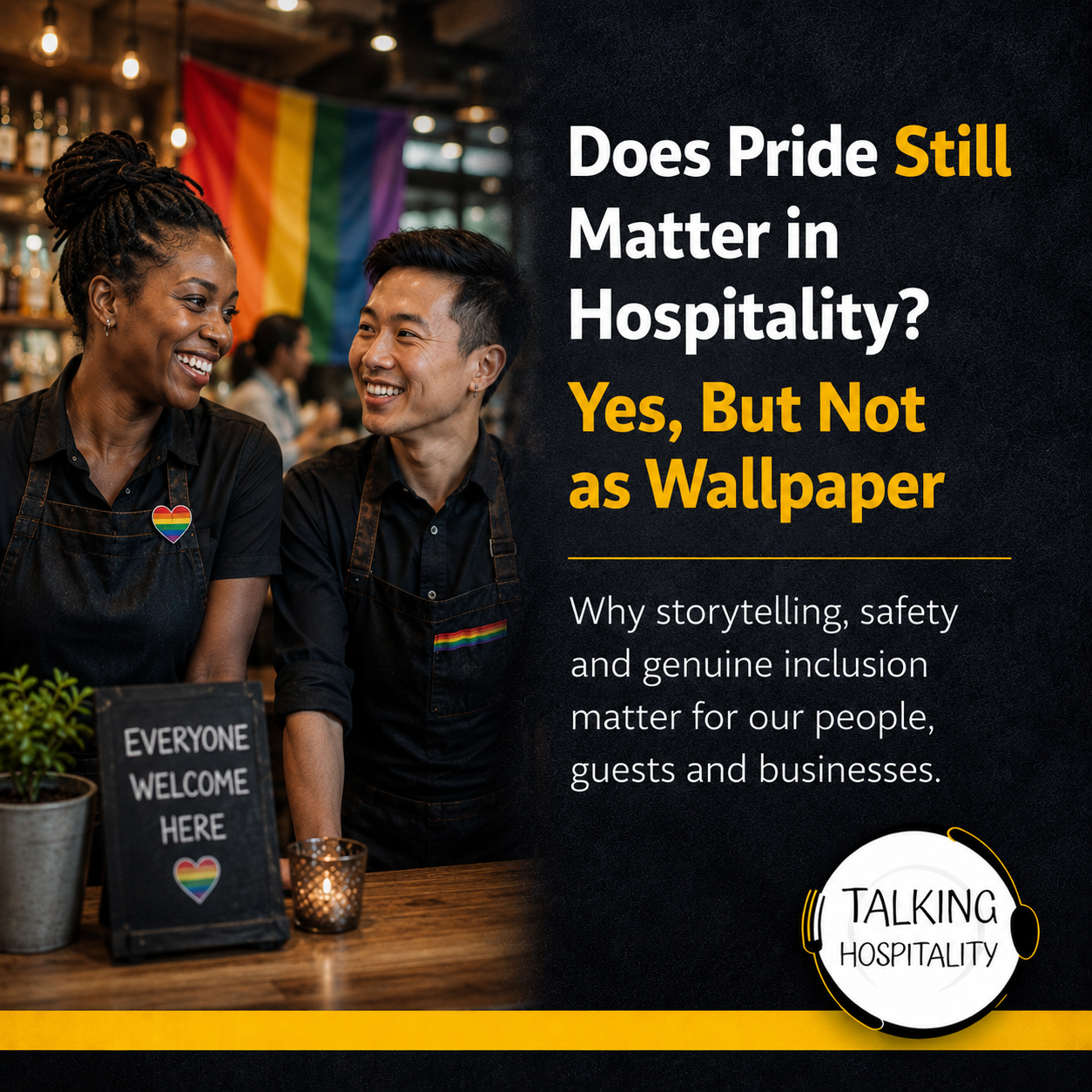
Does Pride Still Matter in Hospitality?
Yes, but not as wallpaper
Suggested category: EDI / Pride Month / Hospitality Leadership
Companion to: PrideWide conversation with Tris Reid-Smith
SEO keywords: Pride Month hospitality, LGBTQIA+ hospitality, PrideWide, EDI hospitality, inclusive hospitality, LGBTQIA+ inclusion
Meta description: Pride still matters in hospitality, but not as a once-a-year gesture. Here’s why storytelling, safety and genuine inclusion matter for our people, guests and businesses.
Stonewall’s 2025 workplace research showed that in the UK 39% of LGBTQ+ employees still hide that they are LGBTQ+ at work, 36% have heard discriminatory comments about LGBTQ+ colleagues, and 26% have experienced negative comments or conduct from customers or clients because of their identity. That last one is particularly relevant to hospitality because guest interaction is central to the work.*
There’s a moment in the PrideWide conversation with Tris Reid-Smith that really sits with you.
Pride isn't just about visibility. It is about communication. It is about stories. It is about hearts and minds.
And in hospitality, that's key.
We are an industry built on welcome. That word gets used so often it almost loses its meaning, but at its best, hospitality is deeply human. We greet strangers, feed people, host celebrations, create spaces, build communities and help people feel like they belong somewhere, even if only for a couple of hours.
So when we ask, “Does Pride still matter in hospitality?” the answer has to be yes.
But here’s the important bit.
Pride only matters if it means something beyond a rainbow logo in June.
Because LGBTQIA+ people are not seasonal. They are not a campaign asset. They are not a “nice to have” for the social media calendar. They are your chefs, managers, receptionists, bartenders, suppliers, guests, trainers, founders, regulars and future leaders.
They are already in the room.
The better question is this: do they feel safe enough to be fully themselves in it?
Pride is not a decoration
One of the strongest points from Tris is that many organisations know how to show support, but not always how to communicate it with meaning.
That is where PrideWide’s work feels so relevant.
Its focus is not just on policy, law or internal statements. It is about storytelling. It is about public understanding. It is about helping LGBTQIA+ people and allies share stories that are human enough to cut through noise, fear and misinformation.
Hospitality should understand this better than most.
We trade in stories.
The story behind a restaurant.
The story behind a family business.
The story behind a dish.
The story behind a guest experience.
The story behind a team that keeps turning up for each other during a brutal service while the printer has clearly chosen violence.
Stories are how people connect.
They are also how assumptions begin to shift.
That matters because prejudice rarely disappears through policy alone. Policy gives people rights, routes and responsibilities. Stories help people understand why those rights matter in real life.
The best inclusion work does both.
Why this is a hospitality issue
Hospitality is one of the most diverse industries in the UK, but diversity on its own is not inclusion.
You can employ a beautifully diverse team and still have a culture where people quietly edit themselves to get through the shift.
The gay team member who changes pronouns when talking about their partner.
The trans colleague who avoids staff facilities because it is easier than dealing with comments.
The non-binary worker who does not want to correct anyone again because they are tired of becoming “the issue”.
The manager who thinks “banter” is harmless because nobody has complained.
But nobody complaining is not always proof of a healthy culture.
Sometimes it is proof that people have given up.
That is a painful thought, but it is also useful. Because it gives leaders somewhere practical to start.
The business case is human first
There is also a commercial reality here.
People do their best work when they are not wasting energy hiding who they are.
If someone is constantly assessing whether it is safe to mention their partner, correct their pronouns, challenge a joke, use a toilet, wear what feels right, or speak honestly about their life, that takes a toll.
It affects confidence.
It affects engagement.
It affects trust.
It affects whether people stay.
And in a sector still dealing with recruitment pressure, retention challenges and leadership pipeline gaps, that matters.
Inclusion is not soft. It is part of building a workplace where people can perform, contribute and grow.
The strongest hospitality businesses understand that welcome must work both ways. It has to be felt by guests, yes. But it also has to be felt by the people delivering it.
Pride needs practical action
A meaningful Pride Month in hospitality does not need to be overcomplicated.
It can start with three questions.
Are our teams safe from homophobia, biphobia and transphobia from colleagues, managers and guests?
Do our policies actually work when something happens, or do they sit nicely in a folder somewhere gathering digital dust?
Have we trained our managers to respond confidently, calmly and consistently?
Because this is where credibility lives.
Not in the post.
Not in the flag.
Not in the themed cocktail someone in marketing named after a disco ball.
Credibility lives in what happens when a guest makes a homophobic comment at the bar.
It lives in whether a manager backs their team.
It lives in whether someone can bring their partner to a work event without scanning the room first.
It lives in whether LGBTQIA+ colleagues are included in development, progression and leadership conversations all year round.
What leaders can do now
If you are a hospitality leader, Pride Month is a good moment to review what actually happens inside your business.
Not what you intend.
Not what the values page says.
What actually happens.
Start here:
-
Check your policies are clear and usable
People need to know how to report discrimination, harassment or inappropriate behaviour. They also need to know what happens next. -
Train managers for real scenarios
A policy is not much use if managers freeze when something happens. Give them language, process and confidence. -
Make guest behaviour part of the conversation
Teams need to know they will be supported if a guest crosses the line. “The customer is always right” was never meant to include abuse. -
Look at progression and visibility
Are LGBTQIA+ people visible in leadership, development opportunities and decision-making spaces? Or only visible during June? -
Keep listening after Pride Month
One listening session in June is not culture change. Regular conversations, staff networks, anonymous feedback and action tracking matter more.
What PrideWide reminds us
The PrideWide message is a timely reminder that the fight for LGBTQIA+ equality is not only fought in courts, boardrooms or campaign offices.
It is fought in everyday spaces where people either feel seen or erased.
Hospitality spaces are some of those everyday spaces.
Hotels, restaurants, pubs, cafés, bars, event venues and member clubs shape how people experience public life. When those spaces are genuinely inclusive, they do more than serve food, drink or beds.
They send a message:
You are welcome here.
You are safe here.
You do not have to shrink here.
That is not soft.
That is strong leadership.
So, does Pride still matter?
Yes.
It matters because progress is not guaranteed.
It matters because silence is not neutral.
It matters because people are tired of being tolerated and ready to be respected.
It matters because the next generation of hospitality talent is watching who actually means it.
It matters because great hospitality has always been about people.
Pride still matters.
But not as wallpaper.
As action.
As storytelling.
As leadership.
As welcome with a backbone.
Watch our PrideWide conversation with Tris Reid-Smith and explore PrideWide’s work supporting LGBTQIA+ storytelling, visibility and public understanding.
*=https://www.stonewall.org.uk/news/new-research-shows-almost-40-of-lgbtq-employees-still-hide-their-identity-at-work

Founder & Host
Timothy R Andrews is the founder and host of Talking Hospitality, a UK hospitality podcast, media and learning platform for experienced industry leaders.
With more than 20 years’ experience in hospitality and recruitment, including 16 years running his own hospitality recruitment business, Timothy brings a strong people, leadership and talent perspective to the conversations he hosts.
Through Talking Hospitality, he explores the issues shaping the industry across People & Culture, Operations and Technology, bringing together operators, founders, people leaders and industry specialists to share experience, challenge assumptions and identify practical ways forward.
Alongside the podcast, Timothy works across hospitality media, events, training and learning, with a particular interest in leadership, career progression, inclusion, learning and development, and how new technology is changing the industry. He also wrote **Only A Pavement Away**, performed by Cameo Williams, supporting the hospitality charity Only A Pavement Away.
A Worker Asks to See Their Tipping Records. What Happens Next?