Are Rainbow Flags Enough for LGBTQIA+ Inclusion?
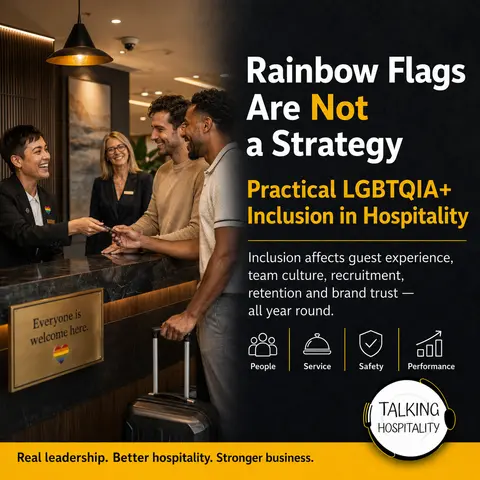
Are Rainbow Flags Enough for LGBTQIA+ Inclusion?
The business case for making Pride practical, not performative
A rainbow flag in June can be a nice gesture. But it cannot be the whole strategy.
For hospitality businesses, LGBTQIA+ inclusion needs to show up in the way you lead teams, welcome guests, manage behaviour, train managers, handle complaints, recruit people and build trust all year round.
This is not about politicising the workplace. It is about running a better, safer, more commercially aware hospitality business.
Let’s get straight to it.
Putting a rainbow flag up in June is not a strategy.
It may be well meant. It may look cheerful. It may make the front of the building look a bit more alive than usual. But if that flag is doing all the heavy lifting, we have a problem.
Because LGBTQIA+ inclusion is not a design choice. It is not a social media theme. It is not a June-only activity that sits somewhere between a cocktail special and a hastily approved Instagram post.
In hospitality, inclusion is operational.
It lives in the booking journey. It lives at reception. It lives in the way a manager responds when a guest makes a homophobic comment at the bar. It lives in whether a trans team member feels safe changing their name badge. It lives in whether a same-sex couple are treated like any other couple checking into a hotel, rather than being asked, “Did you mean twin beds?”
Tiny moments. Big impact.
And as Tris Reid-Smith from PrideWide discussed on Talking Hospitality, this is why Pride still matters. PrideWide’s work focuses on storytelling, visibility and changing the narrative so LGBTQIA+ people can thrive wherever they live. The organisation describes its ambition as building a world where LGBTQIA+ people can thrive, and its work includes helping businesses move beyond seeing LGBTQIA+ people as a tick-box or policy issue. (Pride Wide)
That point matters for hospitality.
We are a people industry. We do not sell beds, plates, pints and meeting rooms in isolation. We sell welcome, safety, atmosphere, memory and belonging. If people do not feel safe in our spaces, we have failed at the most basic level of hospitality.
And before anyone says, “But surely we’re past all this now?” — no, we are not.
Stonewall’s 2025 research found that 39% of LGBTQ+ employees still feel the need to hide who they are at work, 36% of employees have heard discriminatory comments about an LGBTQ+ colleague, and more than one in four LGBTQ+ people had experienced negative comments or conduct from customers or clients because of their identity. (Stonewall UK)
That last point should make every hospitality leader pause.
Customers and clients are part of our working environment. We spend a lot of time talking about “guest experience”, but what about the team member who has to smile through a comment they should never have had to hear in the first place?
There is a business case here, but it is not a cold, spreadsheet-only argument. It is much more human than that.
Hospitality is still dealing with workforce pressure, recruitment difficulty and retention challenges. UKHospitality’s workforce strategy describes labour needs across recruitment, skills, training, working lives, the image of hospitality as a career, and the infrastructure needed to support employees. (UKHospitality) So why would any business make it harder for people to stay?
If someone feels they have to hide a part of themselves every day before they even start service, that is not just emotionally exhausting. It is performance-draining. Nobody gives their best when they are busy editing themselves.
Deloitte’s LGBTQ+ workplace research found that only 52% of LGBTQ+ workers in the UK felt comfortable being out at work, and one in five were considering leaving their current role because of a lack of focus or action on LGBTQ+ inclusion. (Deloitte) That is not a “nice to know” statistic. That is a retention issue.
And retention, as every hospitality leader knows, is not fluffy.
Replacing good people costs time, money, morale and momentum. It disrupts rotas. It weakens service. It puts pressure on the people who stay. Then we wonder why the atmosphere feels off and why the guest experience becomes inconsistent.
Funny that.
The legal basics matter too. In Great Britain, the Equality Act 2010 protects people from discrimination in the workplace and wider society, including on the basis of sexual orientation and gender reassignment. (GOV.UK) Acas also makes clear that harassment related to protected characteristics, including sexual orientation and gender reassignment, can fall under discrimination law. (Acas)
But legal compliance is only the floor.
The better question is: what kind of business are you trying to build?
If the answer is “one where people want to work, guests want to return, and managers know how to deal with issues properly”, then LGBTQIA+ inclusion belongs in your leadership practice, not just your marketing calendar.
This is where some businesses get stuck. They think inclusion has to be complicated. They imagine a huge policy project, a consultancy bill, and someone in the team being handed the unofficial role of “Pride person” because they once wore a rainbow lanyard.
It does not need to start there.
Start with everyday hospitality.
Look at the guest journey. Are your booking forms making assumptions about gender, titles or relationships? Are your wedding packages written only with “bride and groom” language? Do your hotel teams default to awkwardness when two men ask for a double room? Are your door teams clear on how to handle anti-LGBTQIA+ abuse from customers?
Look at the team journey. Do people know how to report concerns? Do managers know what to do when “banter” crosses a line? Do your uniforms work for different bodies and gender expressions? Are name changes handled respectfully and discreetly? Do you have one standard for everyone, or does it depend which manager is on shift?
That is where inclusion becomes real.
Not in a slogan. In a standard.
Here is a practical example.
A guest at the bar makes a loud comment about another guest’s sexuality. The bartender hears it. The supervisor hears it. Everyone freezes for half a second.
In a weak culture, people pretend they did not hear it. The target of the comment leaves. The team member feels embarrassed. The guest who made the comment learns that the venue tolerates it.
In a stronger culture, the supervisor calmly steps in and says: “We don’t speak about people like that here. You’re welcome to stay if you can be respectful.”
No drama. No lecture. No social media statement required. Just leadership.
That is what practical inclusion looks like.
And yes, guests notice.
Younger customers and workers are more likely to identify as lesbian, gay or bisexual than older groups. ONS data for 2024 estimated that 3.7% of the UK adult household population identified as LGB, rising to 8.0% among people aged 16 to 24. (Office for National Statistics) These are current and future team members, guests, clients, wedding couples, event bookers and brand advocates.
If your business wants to stay relevant, it cannot afford to treat LGBTQIA+ inclusion as a side issue.
The commercial piece also extends to brand trust. A 2024 global study by the Unstereotype Alliance, convened by UN Women and involving Oxford Saïd Business School, found that more inclusive advertising was associated with stronger short-term and longer-term sales, higher customer loyalty, stronger brand equity and greater pricing power. (unstereotypealliance.org)
Now, that does not mean every hospitality business should throw rainbows over everything and hope the tills ring louder. That would be missing the point entirely.
The lesson is not “make louder Pride content”.
The lesson is “make sure your public message matches the lived experience”.
Because people are increasingly good at spotting the gap.
If your Instagram says “everyone welcome” but your team WhatsApp is full of lazy jokes, there is a gap.
If your venue hosts a Pride night but your managers do not know how to support a trans colleague, there is a gap.
If your hotel wants LGBTQIA+ wedding bookings but your brochure language still assumes every couple is heterosexual, there is a gap.
And in hospitality, gaps become guest complaints, staff exits, poor reviews and reputation damage.
So what should hospitality leaders actually do?
First, set the standard clearly. Not with a 47-page document nobody reads. With simple expectations that every manager can repeat: we treat people with respect, we do not tolerate discriminatory behaviour, and we act when something happens.
Second, train managers in real scenarios. Not abstract theory. Use the moments they actually face: customer abuse, inappropriate jokes, pronoun mistakes, room allocations, wedding enquiries, staff complaints, toilets, uniforms and team WhatsApp groups.
Third, review the guest journey. Look at your website, booking forms, event packages, scripts, signage and complaint process. Ask yourself where an LGBTQIA+ guest might feel awkward, unseen or unsafe. Then fix the friction.
Fourth, review the employee journey. Recruitment, onboarding, policies, uniforms, app profiles, rota systems, name badges, staff facilities and reporting routes all matter. Inclusion often fails in the admin, not the intention.
Fifth, stop making LGBTQIA+ colleagues carry the whole thing. Ask for input, yes. But do not turn identity into unpaid consultancy. Leaders need to lead.
Sixth, measure it. Add inclusion questions to pulse surveys. Track complaints and exit interview themes. Ask managers what situations they feel underprepared for. Look for patterns. What gets measured usually gets taken more seriously.
A simple 30-day action plan could look like this:
Week one: audit the obvious guest and team touchpoints.
Week two: run a short manager conversation on how to respond to discriminatory comments from guests or colleagues.
Week three: update one or two practical things, such as booking language, reporting routes, or team standards.
Week four: communicate the standard clearly and make it part of induction, not just Pride Month.
None of this requires perfection.
Actually, perfection is often the excuse for doing nothing. “We need to get it absolutely right first” can quickly become “let’s quietly park it until next June”. Convenient, but not exactly leadership.
The better approach is to be honest, practical and consistent.
Say what you stand for. Train people properly. Deal with issues when they happen. Learn when you get something wrong. Keep going when June ends.
That is how hospitality builds trust.
Because the real business case for LGBTQIA+ inclusion is not just that it helps attract customers, retain staff or protect reputation, although it does all of those things.
The real business case is this: people remember where they felt safe.
They remember the hotel where nobody made their wedding feel unusual.
They remember the restaurant where they could hold hands without being stared at.
They remember the manager who stepped in calmly when a customer crossed the line.
They remember the workplace where they did not have to shrink themselves to fit in.
And in a sector built on repeat visits, recommendations, loyalty and word of mouth, that memory matters.
So yes, put up the flag if it means something.
But do not make the flag do the work.
The work is leadership. The work is culture. The work is standards. The work is everyday hospitality, done properly.
Watch our PrideWide conversation with Tris Reid-Smith and reflect on what Pride means inside your own business, not just outside the front door.
Talking Hospitality exists to share real experiences, practical learning, and honest conversations that help hospitality professionals lead better, work smarter, and look after themselves and their teams.

Founder & Host
Timothy R Andrews is the founder and host of Talking Hospitality, a UK hospitality podcast, media and learning platform for experienced industry leaders.
With more than 20 years’ experience in hospitality and recruitment, including 16 years running his own hospitality recruitment business, Timothy brings a strong people, leadership and talent perspective to the conversations he hosts.
Through Talking Hospitality, he explores the issues shaping the industry across People & Culture, Operations and Technology, bringing together operators, founders, people leaders and industry specialists to share experience, challenge assumptions and identify practical ways forward.
Alongside the podcast, Timothy works across hospitality media, events, training and learning, with a particular interest in leadership, career progression, inclusion, learning and development, and how new technology is changing the industry. He also wrote **Only A Pavement Away**, performed by Cameo Williams, supporting the hospitality charity Only A Pavement Away.
A Worker Asks to See Their Tipping Records. What Happens Next?