Why Visibility Is the Real Lever for Change for Women in Hospitality
In our recent Talking Hospitality conversation with Mex Ibrahim, co-founder of Women in the Food Industry, one theme surfaced again and again.
Visibility.
Not visibility for applause.
Not spotlight for ego.
Visibility as infrastructure.
Because when women are not seen, progression feels theoretical.
And when progression feels theoretical, it stalls.
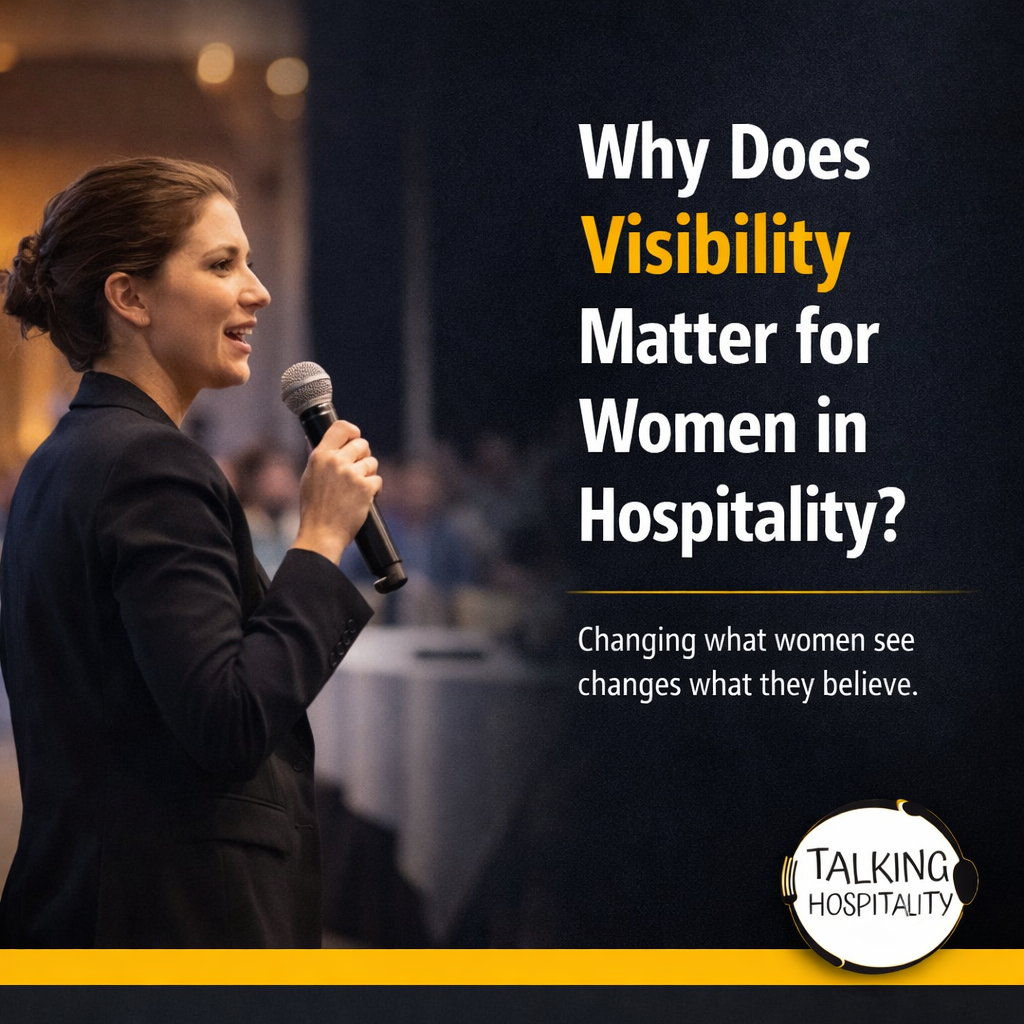
You Can’t Progress Into Roles You Never See
Mex references a line often attributed to Beyoncé: "You can’t be it if you can’t see it".
It sounds simple. It isn't.
Hospitality employs a majority female workforce. Yet when media coverage, awards panels, keynote stages and executive teams are examined, representation narrows dramatically.
Perception, therefore, doesn't match the reality of the numbers.
If a young woman entering hospitality only sees men as executive chefs, group operations directors, owners, or industry spokespeople, something subtle happens. Leadership becomes coded. Not consciously. Structurally.
Women in the Food Industry was created specifically to counter that invisibility . By spotlighting food scientists, producers, bakers, policy experts and entrepreneurs, the organisation expands the visible definition of success.
And that expansion matters.
Why? Because when the definition of success widens, ambition widens with it.
If leadership in hospitality is only ever represented by one profile — one route, one background, one personality type — then progression feels narrow. Constrained. Conditional. People start subconsciously editing themselves to fit what already exists rather than imagining something different.
When visibility expands, three important shifts happen.
First, career imagination increases. If women see food scientists, policy leaders, drinks founders, multi-site operators, brand directors and entrepreneurs — not just chefs or general managers — the possible routes multiply. Hospitality stops looking like a single ladder and starts looking like a network.
Second, confidence becomes contextual rather than personal. When women can hear honest stories about funding struggles, imposter syndrome, maternity return, menopause challenges, or late-career pivots, they will realise their own doubts are not evidence of inadequacy. They are part of the journey. That reframing keeps people in the industry longer. They are also not alone in their experiences.
Third, organisations begin to recalibrate what leadership looks like. Visibility influences boards, investors and owners as much as it influences individuals. When senior women are consistently seen speaking, scaling businesses and shaping policy, it changes hiring assumptions. It changes succession planning. It changes who gets put forward for stretch roles.
In short, visibility expands both belief and behaviour.
And in an industry already battling recruitment and retention pressures, expanding belief may be one of the most commercially strategic decisions leadership teams can make.
Visibility Reduces Isolation
One of the most powerful elements in the episode is Mex’s discussion around imposter syndrome .
Many women assume that if they are struggling, doubting themselves, or facing barriers, it must be personal failure.
Visibility will help dismantle that narrative.
When stories are told honestly, from including funding struggles, confidence dips, career pivots, it normalises the experience of progression and achievement.
That does two things:
It removes shame
It builds belief
Research from Harvard Business Review consistently shows that role models significantly influence leadership ambition, particularly for underrepresented groups. When women see leaders who share elements of their identity, ambition rises measurably.
In hospitality, where career pathways are often informal rather than structured, visible examples are therefore essential, and should not be underestimated.
Visibility Is Not Just Media Coverage
But.
There is a risk.
Visibility can become surface-level.
A panel during International Women’s Day.
A feature in a trade magazine.
A social media post spotlighting a female manager.
All positive. None sufficient.
True visibility is structural.
It shows up in:
Who speaks at industry conferences
Who is quoted as an expert
Who is promoted internally
Who is profiled on company websites
Who sits on boards
Data from WiHTL consistently highlights that senior leadership in hospitality still skews male, despite workforce demographics. That imbalance reinforces itself unless visibility is actively managed.
What Do We Mean When We Say “True Visibility Is Structural”?
We use that phrase a lot. But what does it actually mean?
Structural visibility goes beyond celebration. It goes beyond campaigns, panels and one-off posts.
It means visibility is embedded into how an organisation operates.
Here’s the difference.
Symbolic visibility looks like:
A feature during International Women’s Day
A social post spotlighting one senior woman
A diversity panel once a year
A press quote when it feels appropriate
All good. None transformative.
Structural visibility looks like:
Women consistently representing the business at industry events
Female leaders named as spokespeople in press releases
Promotion pathways clearly mapped and published internally
Women sitting on decision-making boards, not just advisory panels
Internal communications regularly highlighting female-led projects
Succession planning that deliberately includes women in the pipeline
Structural means repeatable. Measurable. Normalised.
When visibility is structural, it is not dependent on goodwill. It is part of how things operate, governance if you will.
Why does that matter?
Because informal industries default to familiarity.
Hospitality is relationship-driven. Leaders often promote people they trust, people they know, people who look and behave like those who came before them. Without conscious structure, visibility narrows naturally.
Structural visibility interrupts that pattern.
It ensures:
Exposure is not accidental
Opportunity is not personality-dependent
Recognition is not proximity-based
It also signals something powerful internally.
When women see other women repeatedly occupying expert space (for example: chairing meetings, leading investor conversations, representing brands publicly) it changes perception at every level of the organisation.
Ambition rises because the pathway looks real.
And from a commercial standpoint, structural visibility strengthens retention. People stay where they can see a future version of themselves.
So when we say “true visibility is structural”, what we mean is this:
If women only become visible during awareness months, nothing changes.
If women are consistently visible in leadership, influence and expertise year-round, culture shifts.
That is when visibility stops being symbolic and starts being strategic.
The Lifecycle Factor
Mex also speaks about structural pressures that disproportionately affect women: punishing hours, childcare limitations, maternity breaks, menopause .
Visibility intersects with all of these.
When women do not see:
Senior leaders who have taken maternity leave and returned
Executives openly discussing menopause
Flexible leadership models
Shared parental leave examples
They assume those routes are incompatible with progression.
Countries such as Sweden and Norway, where childcare infrastructure and parental leave policies are more balanced, demonstrate higher female representation in leadership across industries. The lesson is not that hospitality must change its operating hours. It is that systems surrounding work can evolve.
Visibility makes those evolutions imaginable and, therefore, believable and (most importantly) achievable.
Real Examples of Visibility Driving Change
We see this working in practice.
Asma Khan’s rise from supper club to international recognition changed the narrative of who can enter professional kitchens later in life.
Emma Heal, MD of Lucky Saint, regularly speaks publicly about brand leadership and growth, normalising female executive presence in drinks .
Ramona Hazan openly shares the journey of building Ramona’s Kitchen from family recipe to supermarket brand .
These stories are not aspirational fluff. They are case studies in possibility.
And possibility drives pipeline.
What Leaders Can Do Now
If visibility is the lever, then leaders control the mechanism.
Here are practical actions:
1. Audit Who Is Visible
Review your website, marketing materials, speaker lists and social channels.
Who represents your leadership publicly?
2. Rotate Conference and Media Opportunities
Ensure senior women are put forward for panels and commentary. Not once. Repeatedly.
3. Spotlight Internal Progression
Celebrate promotions visibly and explain the pathway taken.
4. Normalise Lifecycle Conversations
If senior women are comfortable, allow open dialogue about maternity return, menopause, and flexible leadership models.
5. Invest in Networks
Encourage engagement with organisations like Women in the Food Industry and Hospitality Action, where community and wellbeing support reinforce retention.
Why This Matters Commercially
Retention is expensive. Recruitment is harder than it has been in years.
When people cannot see a future, they leave.
When they can, they stay and build.
Visibility reduces attrition because it reduces doubt.
It also broadens your talent pipeline, strengthens culture, and improves decision-making diversity. McKinsey research repeatedly correlates gender-diverse executive teams with stronger financial performance.
This is not about optics. It is about operational resilience.
The Question for the Industry
Visibility is not accidental. It is curated.
If women remain under-represented in senior roles, it is not because talent is missing. It is because infrastructure is not working and most certainly out-dated.
If you want more women leading, make them visible.
Not symbolically but structurally.
Talking Hospitality exists to share real experiences, practical learning, and honest conversations that help hospitality professionals lead better, work smarter, and look after themselves and their teams.

Host & Founder
Timothy R. Andrews has spent over two decades in hospitality. He founded and led a successful recruitment and training business for luxury four- and five-star markets before moving into senior talent leadership roles. Through the podcast Timothy focuses on credible voices, lived experience, and learning that can be applied immediately, giving back to the industry.
Finding Meaning at Work, Even When the Job Feels Dull